
Donkey Kong games can seem simple at first. You run, jump, grab bananas, beat bosses, and keep going. But when players start aiming for full clears, faster runs, or gameplay that also looks smooth on stream, they usually realize there is a lot more going on underneath, and that is a big part of the fun. There is honestly more happening than most people expect. The best Donkey Kong stages feel like clever little systems. Enemies mess with timing, barrels can change a route, and terrain teaches momentum in a very direct way, so players can really feel how movement works. Even collectibles are not just shiny extras. In many cases, they act like hints that show how a level wants to be played.
That is why so many players end up caught between two goals. They want the smooth rhythm of a platformer, but they also want every secret room, puzzle piece, letter, banana bunch, bonus path, and hidden detour. If they move too fast, they miss things tucked behind hazards or hidden in side paths. However, if they slow down too much, the game can start to feel stiff and a bit awkward. Understanding the mechanics helps a lot. Once players get a better feel for jumps, rolls, bounce chains, barrel paths, partner abilities, and the way stages are built, collectibles stop feeling random. They start to feel more like part of the route.
This guide explains all of that in plain language. It looks at how Donkey Kong uses collectibles to guide exploration, how movement changes item routes, and why rewards are hidden where they are. It also covers how skilled players optimize runs without losing control, especially in faster sections. It includes streamer-friendly tips, common mistakes, accessibility ideas, and a quick FAQ for players aiming for cleaner 100% runs. For anyone interested in the wider series history too, Exploring the Lore of Donkey Kong: A Deep Dive into the Franchise adds helpful story context to the gameplay side.
Why collectibles matter more than they seem
In Donkey Kong, collectibles often work like a second language, and that’s not really an exaggeration. They reward skill, but they also quietly teach players to pay closer attention. A trail of bananas can guide you toward a safer jump over a pit, while a puzzle piece hanging over a risky gap often nudges you to try a roll jump. KONG letters might be placed at the start, middle, and end of a stage in a way that tests how well you handle the whole level. Even when a collectible leads to a simple reward, where it sits still says something about timing, confidence, and how a stage is meant to flow.
That matters because Donkey Kong is built around mastery through repetition. On a first run, most players are usually focused on just getting through. Then, on the next attempt, patterns start to stand out. A bit later, it becomes clearer why that banana bunch was floating near a crumbling platform, or why a hidden barrel was tucked behind foreground art and so easy to miss at first. These small details often shape the learning loop. In that sense, collectibles are one of the clearest ways the game teaches.
Here is a simple way to think about the main collectible roles across modern Donkey Kong platformers:
| Collectible Type | What It Usually Tests | Why It Matters |
|---|---|---|
| Banana trails and bunches | Movement line and jump timing | They hint at the safest or fastest route |
| KONG letters | Stage-wide consistency | They push players to engage with the whole level |
| Puzzle pieces or hidden items | Exploration and secret awareness | They reward observation and replay |
| Bonus room access | Precision and route control | They train advanced mechanics under pressure |
For players who care about completion, that means collectibles are not just optional side content. They feel more like a map to the game’s design logic. They also give streamers natural challenge ideas, like no-miss KONG runs or all-secrets attempts. And for anyone interested in design, it’s pretty easy to spot how Nintendo and Retro-style platforming uses item placement to teach movement, timing, and route choices. That’s honestly pretty neat.
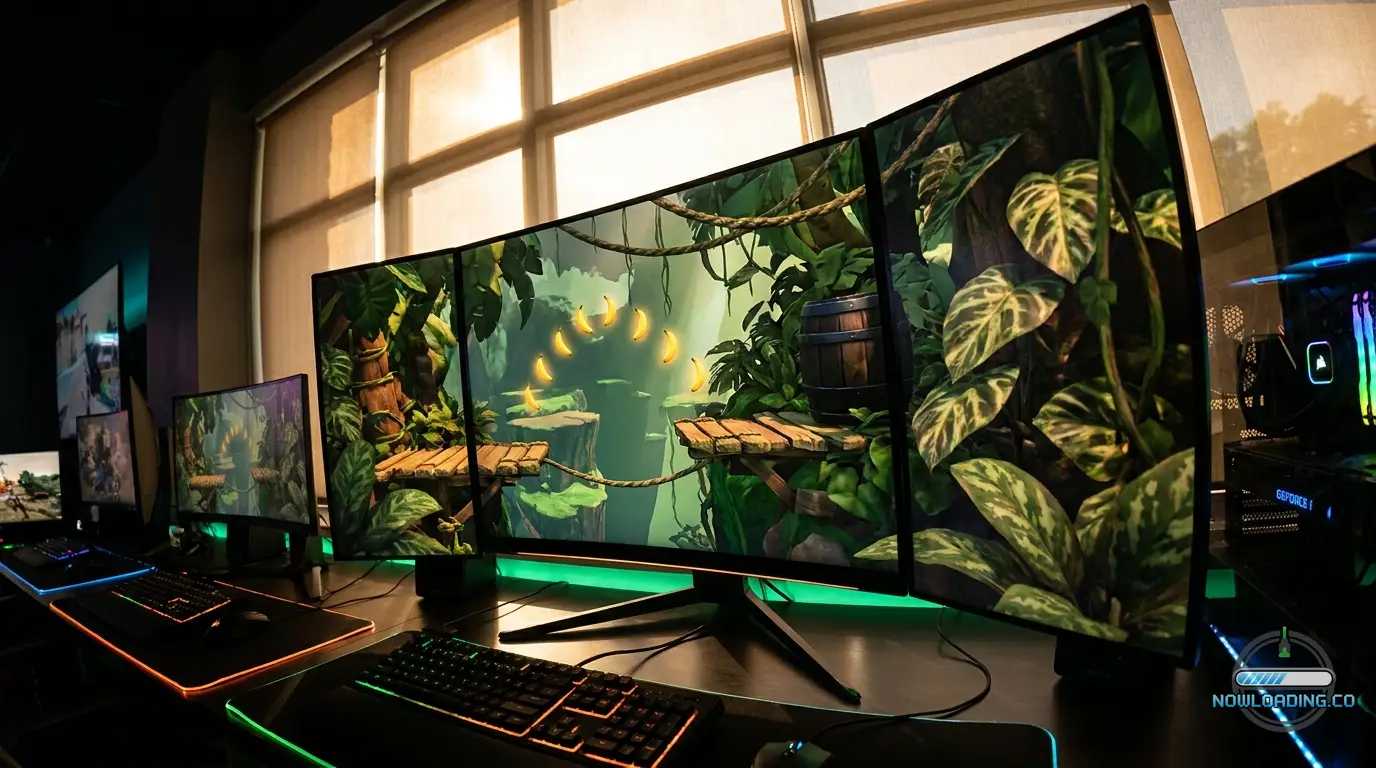
Core movement mechanics that shape every collectible route
To collect well in Donkey Kong, it helps to understand the movement system first. Most missed items happen because of movement mistakes, not because players do not see them. They usually spot the secret. The real issue is often that they do not reach it with the right speed, angle, timing, or setup.
The first big idea is momentum. Donkey Kong usually feels heavier than many mascot platform heroes, and that weight matters a lot here. He commits more to motion, and that is a big part of why the challenge works. A normal jump works for safe platforming, but advanced collecting often asks for a roll into a jump, a bounce off an enemy, or a delayed landing that keeps your forward speed going. If a player stops before every obstacle, that breaks the rhythm many secrets are built around and often loses the distance needed to reach a hidden path.
The second big idea is layered inputs. Many hidden collectibles sit behind moves that combine several actions. It might be a roll jump right from the ledge edge, a barrel throw lined up during a run, or a partner ability that adds extra airtime (the game usually hints at this, but not always). These are not random skill checks. They reward players who understand how separate mechanics connect while moving instead of treating each move like its own isolated trick.
Recovery matters too. Good Donkey Kong play is not about perfect execution every second. It also means fixing mistakes quickly. A missed bounce can still lead to a saved route. An overshot platform may still turn into a recovery through an enemy chain. Competitive players, especially aspiring streamers, should practice this because it keeps runs alive and can look great on camera when a near-miss turns into a save.
When the mechanics are looked at this way, collectibles start to feel more like movement tests with a clear purpose. That shift is usually helpful. So instead of asking, ‘Where is the item?’ the better question becomes, ‘What move is the game trying to teach me here?’
How level design hides secrets in plain sight
The smartest Donkey Kong stages usually do not hide collectibles by making them invisible. Instead, they pull your attention somewhere else. A danger appears in one place, so your eyes move away from another. Music, enemy movement, foreground art, and camera framing all push you along the main route, even when a secret path is right above or below it (which is pretty sneaky). In most cases, that is the real trick: the secret is not completely hidden, but the level makes the safer-looking path in front of you feel like the obvious choice.
That is also why experienced players often find more collectibles on a slow replay than during a rushed first clear. Once they stop treating the stage like a tunnel, they start checking odd spaces, unused corners, suspicious gaps, and banana trails that break the normal logic. Small clues often matter more here. A single banana placed near a wall can probably tell you more than a long, obvious trail left out in the open (and I think the game knows you’ll miss that the first time).
One common pattern is the ‘trust jump.’ The stage presents a gap that looks deadly, yet the item placement hints that a hidden platform is sitting just off-screen. Another is the ‘background fake-out.’ Decorative objects can hide a barrel, door, or alcove when the camera angle leaves only a narrow space visible. Mine cart stages and water stages each use this differently. Silhouette sections do too. The main idea stays the same: the game is testing whether you’re reading the level or just reacting to it.
If you like comparing design ideas across modern action games, Exploring the Lore of Black Myth: Wukong, A Narrative Guide is a very different genre, but it also shows how game worlds teach players through environmental details and visual cues.
Before improving, many players treat secrets like luck. After they learn the design tells, they start noticing repeated patterns instead. A dead-end wall feels suspicious. A cannon angle suddenly makes sense. A strange banana arc starts working like a signpost. That is what turns 60% runs into 90% runs (which, honestly, is a huge jump).
Reading each collectible type like a pro
Collectibles usually don’t need the same mindset, and that’s often the first thing to notice. Using one search style for everything mostly wastes time. Good Donkey Kong players tend to switch methods based on the item type right in front of them, and it’s really pretty simple.
Bananas and bunches
These often work like route markers, which is really handy. They can show jump arcs, safe landings, and the best way through enemy patterns. You can still get through if you ignore them, but you’ll probably miss some of the level’s intended rhythm. In faster play, these trails can also show the smoothest route for keeping your flow when you’re moving fast.
KONG letters
These usually test how aware you are of the whole stage. One letter may be right on the main path, while another leads you into a detour, a bounce, or a hidden room, which is kind of the point. That’s how they’re usually placed through the level.
Panic also gets punished here. Missing the last letter near the end of a long stage really stings, so players often learn to pace a run instead of rushing through every section.
Puzzle pieces and secret rewards
These feel like the real knowledge checks. Some are in obvious challenge rooms, while others hide behind level geometry, breakable objects, alternate exits, and bonus rooms, which you’ll probably miss the first time. A lot of players need two runs, and that’s pretty normal: one to clear, another to hunt, honestly.
Bonus areas
These turn the game into quick little skill tests, which is honestly pretty fun. The timer adds some pressure, but the mechanics stay pretty simple once you break them down. If a run fails, it usually helps to check whether it was timing, reading the camera, setting up movement, or even how the attempt began, since it’s often one of those small things. Most of the time, though, it really seems to come down to setup.
For more route help, Donkey Kong Collectibles Complete Guide: Hidden Locations & Unlock Rewards pairs well with this mechanics-first breakdown. That guide helps once the how behind secrets already makes sense and clearer location tracking is the main goal.
Partner abilities, barrels, and stage gimmicks
A lot of Donkey Kong collectibles are locked behind situational tools, not just raw platforming skill. That is where partner abilities, barrels, animal friends, mine cart sections, rockets, and other stage gimmicks come in, and some of them really can change everything. At first they may seem like one-off twists. But in practice, they usually follow the same basic rule: each tool changes how a route needs to be read.
Partner characters often change jump safety, hover time, recovery space, or hazard control. Because of that, a collectible path with one partner might feel easy, while with another it can suddenly feel tight or even impossible if it is played the same way. Strong players do more than memorize where items are. They learn what kind of toolkit the stage is really asking for, which is often the real test in these sections.
Barrels are a big part of this too. They are more than simple transport. A launch barrel tests the player’s line, and it asks for angle, timing, and sometimes enemy-cycle awareness before the shot is locked in. Hidden collectibles around barrels often use hesitation in smart ways. Fire too early and the secret gets missed. Wait too long and the cycle starts working against the player. That is probably why barrel sections tend to feel so tense, even when they seem simple at first glance.
Stage gimmicks can hide collectibles by changing how the whole level gets played. Silhouette stages or speed-heavy levels, for example, often reduce visual information. In those stages, rhythm usually matters more than tiny detail, so motion memory starts doing more of the work than sight alone. Water stages may slow movement, but they also open up more room to search. Rocket or mine cart levels turn the puzzle into anticipation: not where the item is right now, but where it will be once the forced movement reaches it.
For 100% play, one solid approach is to group stages by gimmick and train one skill at a time. It is simple, but it works. One session can focus on barrel timing, then another on bounce chains or hidden-door awareness. In that view, focused practice tends to work much better than forcing full clears while tilted.
Smart routes for 100% runs and repeatable streaming sessions
If full completion is the goal, route planning matters almost as much as execution. Random replay can still work, but it usually wastes extra time. A better approach is to sort stages into a few simple states: clear but incomplete, nearly complete, and fully solved {or somewhere in between}. From there, it helps to go after the easiest missing items first.
Say a stage is only missing one puzzle piece. Going in with a search plan usually works better than wandering. You will often find it by checking bonus room access points, suspicious off-camera platforms, and destructible objects that were skipped earlier, since small details often matter here. If a stage is missing several KONG letters plus a secret, relearning the full route from the beginning is probably the better option. In many cases, that saves mental energy.
For streamers, repetition can become the format. One session might focus on no-death runs, while another targets all collectibles in one world. In other sessions, safe routes and speed routes can be compared more directly. Clear structure helps a lot here because it gives viewers something easy to follow and keeps gameplay feeling fresher over longer sessions.
Players who want world-by-world support can use Donkey Kong Bananza: Navigating Levels and Collectibles Like a Pro or Mastering Donkey Kong: Navigating Levels and Collectibles for 100% Completion. Those are covered here after the mechanical ideas in this article.
Accessibility, mental load, and why collectible hunting can be tiring
Collectible hunting is fun, but it can start to feel mentally draining pretty quickly. Missing just one item and having to replay an entire stage can turn that focus into frustration fast, and that happens to a lot of people. It isn’t a skill issue. Most of the time, it’s just cognitive load at work. Donkey Kong asks players to manage timing, observation, memory, and execution all at once, and that can be a lot for almost anyone.
One helpful way to play is to cut down on the mental clutter. Keeping each run centered on one goal can make the whole experience feel calmer. Maybe one session is only for KONG letters. Maybe the next is just for puzzle pieces. A smaller goal often makes a run feel more steady and less all over the place. In many cases, that also helps players dealing with attention fatigue or stress, and it can make mistakes feel a bit less annoying too.
Setup matters more than people sometimes think. Low input lag, clear audio, stable frame pacing, and a screen that feels comfortable on the eyes can all make secret hunting easier, since subtle cues are often easier to catch that way. They’re small details, but they help. Players dealing with visual strain will often get more from shorter sessions and extra replays than from long marathon attempts. That matters even more in dark stages or levels filled with motion, where details are easier to miss.
For readers who like broader gaming strategy with a human angle, platforms like Now Loading can be useful. They bring together game guides, hardware, streaming, and player wellness in one place instead of splitting those topics apart. That’s just more practical.
The future of collectible design will probably keep moving toward better visual clarity and smarter hint systems. Even so, classic-style platformers still show that mystery can work well when movement feels good and the game is easy to read.
Common mistakes that make players miss collectibles
A lot of missed collectibles come from habits, not from especially hard levels. One of the biggest is tunnel vision. Players focus on the ground right in front of Donkey Kong and miss upper paths, hidden alcoves, or small hints in the background, and yeah, those are often easy to miss. That usually matters more than people expect. Another common issue is moving too fast. Speed helps a lot when the route is already familiar, but if it is not, players often rush right past useful information.
Not checking odd spaces is another mistake. If a ledge looks just a little too wide, jump into it. When a wall feels strangely empty, try pounding near it. It is a small test, but it often pays off. And when a barrel angle seems strange, it helps to check where it actually sends you. Donkey Kong usually rewards curiosity more than many players think.
Another problem is keeping the same rhythm after a failure. If a collectible was missed three times, pushing harder usually does not fix it. Changing entry speed or jump timing often works better, and it also helps to watch the camera a little more closely. In most cases, small route changes solve the problem faster than brute force.
A useful quick reference looks like this:
| Problem | Likely Cause | Fast Fix |
|---|---|---|
| Missing hidden items | Not scanning for design clues | Replay slowly and watch banana placement |
| Failing bonus rooms | Poor setup before the first move | Pause and identify the opening pattern |
| Missing KONG letters | Rushing late-stage sections | Call out each letter as you pass it |
| Dropping hard jumps | Losing momentum control | Practice roll jumps in safe early stages |
Once players notice their pattern, progress gets faster. Strong players usually look for repeat mistakes instead of hoping for random luck, and that often helps them clean things up.
Frequently Asked Questions
The exact list changes by game, but the big ones are usually bananas or banana trails, KONG letters, puzzle pieces, bonus room rewards, and hidden tokens tied to secrets. Each type tends to test a different skill, like movement, exploration, or full-stage awareness.
Usually, no. Most Donkey Kong games let you finish the main path without finding every collectible. But if you want full completion, extra unlocks, bragging rights, or stronger mastery of the game mechanics, collectibles become the main goal.
Start by clearing stages normally, then return with a focused plan for missing items. Track what you missed, group similar challenge types together, and practice mechanics like roll jumps and bounce chains in easier levels before retrying hard ones. A route-based approach saves time.
Puzzle pieces often hide behind behavior checks, not just secret rooms. You may need to hit an object, take a strange barrel path, trust an off-screen jump, or enter a bonus room you passed without noticing. Slow down and look for anything that breaks the level’s normal visual pattern.
If you want more Donkey Kong coverage, Now Loading has related guides that dig into collectibles, level navigation, and broader series topics. A good next step is pairing a mechanics guide like this one with a stage-by-stage route article for the specific game you are playing.
Understanding collectibles gives you ready-made stream goals, such as all-secrets nights, no-miss KONG runs, or race-style world clears. It also makes your commentary better because you can explain why a route works, not just what button you pressed. That is the kind of insight audiences remember, and Now Loading covers that wider mix of gameplay, setup, and creator-focused strategy.
Final tips for mastering Donkey Kong collectibles
Donkey Kong rewards players who really pay attention, and that’s the main point here. Collectibles don’t feel like random filler spread around a stage. They act more like small lessons built into each level, and that’s a big part of why they’re fun. Bananas often show how to move through an area. Letters ask if a player can stay steady from start to finish. Puzzle pieces usually reward curiosity, especially in strange corners or along riskier paths. Bonus rooms focus on accuracy during certain platforming sections. Once that starts to make sense, the game usually feels much more open.
The main takeaways are pretty simple:
- Learn movement first, especially momentum and roll jumps.
- Read banana trails as route hints through the level, not just decoration.
- Treat each collectible type as its own test, since they are not all asking the same thing.
- Replay slowly to study the level design, then speed up later.
- Break 100% runs into smaller goals instead of doing everything at once.
- Use missed items as feedback on mechanics, not as proof that the player is bad.
Want to get better quickly? One helpful approach is to choose one stage today and run it a few times. Start with a safe clear. Then go back through slowly, even if that feels a bit boring at first. After that, try a focused run and collect everything in one smooth path. It’s a simple drill, but it often teaches more than replaying the level randomly.
Mastering Donkey Kong collectibles is really about learning how Donkey Kong works. The better the mechanics make sense, the less hidden the game feels. Secrets start to feel intentional instead of random. Routes begin to feel natural, and each stage becomes more fun to play, explore, and finish.