
Cloud gaming is well past the “maybe someday” phase. In 2026, it feels much more real, more normal, and honestly more useful than it did even a few years ago. People can jump into big games on a phone, tablet, smart TV, browser, or handheld without first building a high-end PC, which still feels a little wild. That may sound like a small shift, but it is changing how people play, which devices matter most, and even how game libraries are sold.
That does not mean local hardware is going away. Not even close. Competitive players still care about response time, streamers still want stable setups, and plenty of players simply like owning powerful gear. Still, one of the biggest gaming trends in 2026 is not really about replacing consoles or gaming PCs at home. It is more about flexibility. Cloud gaming is becoming a second option for the industry instead of a full replacement, and in some cases it is simply the easiest way to start playing, especially for anyone who does not want to deal with setup.
For gamers, creators, indie fans, and people who want less hassle, that matters in real ways. It can lower costs, reduce setup stress, open the door to more games, and make cross-device play feel normal in a way that often seemed less practical not that long ago. It also raises real questions about latency, ownership, subscriptions, wellness, and what “good enough” performance usually means depending on the genre.
In this guide, the focus is on where cloud gaming stands now, what the numbers show, which trends are gaining speed, and which predictions for 2026 actually hold up. It also looks at what all of this means for streamers, competitive players, accessibility, and everyday gaming habits, the part that often gets missed. So this is not just about tech. It is about how people actually play.
Cloud Gaming Is Growing Fast, Even If The Numbers Do Not Fully Match
A quick look at market research shows the same basic trend: cloud gaming is growing fast, even if analysts measure it in different ways. Some reports count only service revenue, while others include broader streaming categories, bundled subscriptions, and regional differences, which often explains part of the gap. Because of that, the exact dollar total changes depending on the method being used.
Even with those differences, the direction is still easy to see. Grand View Research estimated the market at $2.27 billion in 2024 and $3.36 billion in 2025, with a projected 44.3% CAGR from 2025 to 2030. Mordor Intelligence estimated $6.23 billion for 2026 and a 28.25% CAGR from 2026 to 2031. Fortune Business Insights published a much larger $23.79 billion 2026 estimate. DFC Intelligence also projected cloud gaming and interactive streaming businesses reaching $13.5 billion by 2026.
So the exact total usually depends on what gets counted, but the bigger pattern is hard to miss. Growth is steep, and there is no real sign here that it is slowing down.
| Metric | Value | Year |
|---|---|---|
| Cloud gaming market size | $2.27 billion | 2024 |
| Cloud gaming market size | $3.36 billion | 2025 |
| Cloud gaming market size | $6.23 billion | 2026 |
| Projected CAGR | 44.3% | 2025-2030 |
| Projected CAGR | 28.25% | 2026-2031 |
There is another sign that may matter even more to players than revenue alone: audience size. Statista Market Insights projected 482.3 million cloud gaming users in 2026, along with 6.1% global penetration. That suggests cloud gaming is no longer a niche category. At the same time, it still is not the default way most of the world plays, at least not yet. It is becoming a major part of the wider gaming ecosystem without fully taking it over.
According to analysts at Boston Consulting Group, the bigger shift is strategic: games are becoming more hardware-agnostic. In practical terms, that means almost any screen can work as a platform, letting people play across more devices instead of staying tied to a single piece of hardware.
The Biggest Shift Is Not Power, It Is Access
The old gaming model was pretty simple. If someone wanted better visuals and smoother performance, they needed stronger hardware. That still mostly holds true, but cloud gaming changes who can actually take part. In 2026, access matters almost as much as raw power, and that is a big part of the change.
Instead of asking, “Can my machine run this?” more players now ask, “Can I stream this here, right now?” That may sound small, but it likely changes how people play in a real way. Someone might start an RPG on a tablet, pick it up later on a laptop, then switch over to a TV at night. A streamer might get everything working from another room. A college student might play newer games without spending a huge amount on a GPU, which is a very practical change.
That is one reason cloud gaming works so well with broader gaming trends 2026. Players want portability and less friction, and they usually want to move between devices without feeling tied to one box, whether that is a console under the TV or a desktop in the bedroom. Cloud services are starting to answer that in many cases.
The easiest way to picture this is as a chain with fewer breaks:
What access-first gaming looks like in 2026
- Less waiting through long downloads before you try a game
- Less hardware strain, especially for casual and mid-core players, which honestly often helps
- More gaming in browsers, on TVs, on handhelds, and on tablets
- Simpler ways to try genres you’d usually skip
- Better cross-device habits when your schedule’s busy, and that usually matters in real life
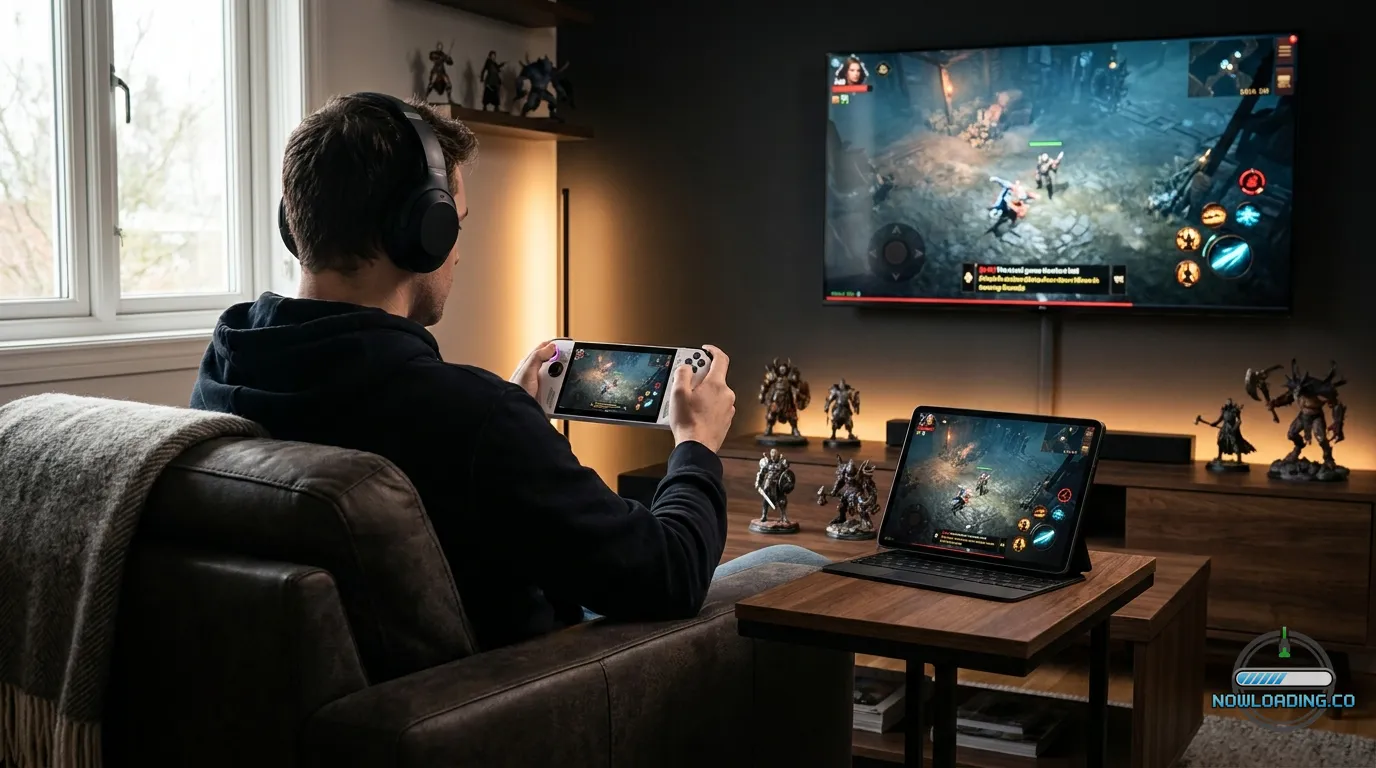
That also helps explain why Now Loading has covered future-facing gaming tech from a few angles. Cloud isn’t really a side topic anymore. It now shapes hardware, streaming, accessibility, and, I think, even how people build healthier gaming routines.
Subscription Models Are Becoming The Default Cloud Gaming Shape
If there’s one 2026 prediction that feels pretty safe, it’s this: subscription-first cloud gaming will likely keep moving ahead. Players seem more comfortable with access-based models than with one-time cloud purchases.
That doesn’t mean every service does it the same way. Some connect cloud gaming to a broader membership, which is often the main draw, while others center on a rotating catalog. A few lean more toward a bring-your-own-library model. Even so, the bigger pattern is easy to see. Cloud gaming usually works better when it’s part of a wider ecosystem instead of feeling like a small add-on inside an app or subscription.
The reason is fairly practical. Subscriptions make it easier to try things without thinking too hard about every choice. You can spend an hour with a racing game, switch to a co-op shooter, and then try an indie game a friend mentioned. That kind of easy jumping around often makes discovery simpler. It can also help when working through a backlog and making content.
There is a trade-off, though. Ownership can feel less certain. Catalog churn is frustrating, especially when a game you planned to finish disappears from the service. So for players who care a lot about keeping permanent access, local installs and bought copies still matter.
A simple before-and-after view helps here:
Before cloud subscriptions felt normal
- First, you’d buy the hardware
- Then you’d get the game
- Download it and install it all
- And hope it ran smoothly, which it often didn’t. Fingers crossed.
What 2026 cloud habits look more like
- One subscription lets people jump straight in
- A much bigger library is there to look through
- Games are easy to try fast, then keep playing on another device if they click
That shift matters for indie games too, and that’s probably a good thing. When there’s less friction, more people will usually try smaller titles. That can be huge for hidden gems, helping them reach players who might never risk a full download or a full purchase on a blind gamble. And for more on where access meets new tech, the site’s gaming innovations in 2026 article fits well with this trend and is worth a look.
Handhelds, Tablets, And Cloud Are Blending Into One Category
One of the more interesting cloud gaming trends is how portable hardware is changing. In 2026, the line between a handheld gaming device, a mobile screen, and a cloud terminal is getting harder to see, and that trend looks likely to keep going.
That matters because many players no longer want to choose between convenience and more serious gaming. They want both in one setup. A handheld might run local indie games at home, then switch to streamed AAA games while traveling or when the device itself cannot run larger titles. A tablet can turn into a flexible gaming screen once a controller is attached. Even a smart TV can act like a living-room console without actually being one.
Research points the same way. Mordor Intelligence says tablets are projected to grow at 28.61% CAGR, and it also noted that Logitech sold 500,000 G Cloud handhelds in 2025. Those figures do not prove that every gamer wants a cloud handheld. They do suggest real demand for low-power devices built around easy access, comfort, and portability, which is often what many people care about most in everyday use.
| Metric | Value | Year |
|---|---|---|
| Tablet segment projected CAGR | 28.61% | 2026-2031 |
| Logitech G Cloud units sold | 500,000 | 2025 |
| Asia Pacific revenue share | 38.45% | 2025 |
For streamers and hobbyists, that opens up some new use cases. It is genuinely useful in practice. They can scout games, manage lighter sessions, or capture ideas without needing to sit at a desk every single time. Indie players get faster access to more unusual games across a wider range of devices. Co-op fans also get easier drop-in play. That is part of why cloud-aware articles like Arc Raiders loadout paths in cloud gaming environments feel more relevant now than they did a few years ago, especially for people using more than one screen.
5G, Edge Networks, And Smarter Infrastructure Are Quietly Doing The Hard Work
Cloud gaming usually lives or dies on one thing: how the connection feels. Big market forecasts do not mean much if a game starts stuttering in the middle of a firefight, which is often the worst possible moment. That is why the less flashy part of this story probably matters most. Better infrastructure is doing steady, practical work in the background, and it is handling a lot of the hard work quietly.
5G rollout, edge computing, regional server expansion, and AI-related technical improvements are making it more likely that cloud gaming feels playable on more devices and in more places. According to Mordor Intelligence, growth in 5G, edge infrastructure, publisher adoption, and AI-related improvements is expanding real use cases, especially on lower-power hardware such as phones, tablets, and basic laptops. That is the part people often miss.
Here is the simple version. When processing happens closer to the player, often on a nearby regional server, and the network path stays more stable, delay usually feels lower. That does not magically remove latency, but it can cut it enough for many genres, including racing, shooters, and action games, at least in most cases. And that is what matters when someone is actually playing, not just reading about the technology.
Genres likely to benefit most in 2026
- Single-player action games
- Story-focused games
- Turn-based games
- Co-op games with a steadier pace
- Casual multiplayer and party games
Genres that will stay more selective
- High-stakes esports
- Frame-tight fighters
- Top-level ranked shooters
- Rhythm games with strict timing
This is the point a lot of articles usually miss: cloud gaming does not have to lead every genre to win a big part of the market. It only has to work well enough in more everyday situations, like travel, shared rooms, or tighter budgets. That is already a big shift. If someone’s gaming life includes any of that, “good enough in more places” can often matter more than “perfect only at one desk at home,” and that is probably the real trade-off here. That mixed approach also fits hardware-focused reading like custom controller setups for FPS dominance, since stronger local gear and cloud access can sit side by side in the same setup.
Competitive Players Will Use Cloud Gaming Carefully, Not Blindly
For ranked grinders and tournament-focused players, cloud gaming in 2026 still won’t be a one-size-fits-all answer. That’s probably where the hype needs a real reality check, and honestly, it often does.
Even as services get better, a lot of competitive players will still treat cloud gaming more like a support tool than a full replacement. It works for warm-up sessions, VOD review, theory practice, and getting into an account while away from a main setup. But when the pressure goes up, during ranked pushes, qualifiers, or tournament matches, local hardware still has a clear edge in trust, and that still feels reasonable.
That doesn’t mean cloud gaming failed. It’s usually more about fit than quality. Just like players wouldn’t use the same sensitivity setup for every shooter, they shouldn’t expect one delivery model to suit every kind of playstyle equally well.
So the real change in 2026 isn’t total acceptance. It’s that people will often use cloud gaming more carefully and with better judgment, especially when the stakes are actually high.
A realistic hybrid setup for competitive players
For competitive players, a hybrid setup usually makes the most sense. Local hardware is still the safer option for ranked matches and tournament play, where reliability matters most. Cloud works well for drills, late-night sessions, travel play, and testing patches on secondary devices. It can also help keep key settings synced across devices when possible, and cloud can be useful for strategy review too.
The same pattern usually fits streamers. Cloud gives more flexibility, making it easier to jump in from different setups. But when reliability comes first, primary production often works better on local hardware, especially for live broadcasts or sponsored streams. That is the short version.
The broader ecosystem is moving this way as well. Cross-platform access and low-friction play are now often expected as basic features rather than small extras.
This also matters around blockbuster launches. Big games can strain hardware budgets and use up storage quickly, so fast remote access will probably keep looking more appealing during major releases. That shift connects to wider audience behavior around GTA 6 launch predictions.
Accessibility And Mental Wellness May Be Two Of Cloud Gaming’s Biggest Wins
Some of cloud gaming’s biggest benefits usually have less to do with graphics than people expect. They’re more about who gets to play, how easy it is to get started, and how much pressure gaming puts on people, which can be easy to miss. From that angle, that’s a pretty big deal.
Cloud gaming lowers the hardware barrier. That can matter a lot for students, budget-minded players, people in shared homes, and players in places where mobile access is more common than owning a console. It may sound like a small change, but the effect can be quite significant. It can also work well with accessible controllers, remapping tools, larger displays, and room setups that are easier to adjust, which for some people matters a lot.
The knowledge base around gaming tech and AI points to another useful angle. Over time, server-side processing may support more adaptive systems, including features for subtitles, menus, speech tools, and dynamic difficulty. In many cases, that could make games easier to use and easier to adjust for different needs. Even so, that kind of future still depends on privacy and transparency. It still looks promising.
There’s also a wellness side to this. Chasing upgrades can be expensive and, honestly, stressful. Cloud gaming may reduce some of that pressure. As a result, gaming can feel more like something people do when they want to, instead of a hardware race that never really slows down and often doesn’t need to.
In BCG’s 2025 gaming survey, 60% of players said they had tried cloud gaming, and 80% said the experience was positive. That doesn’t mean every service feels amazing. It does suggest that more players are finding practical value than many skeptics expect, and that’s worth noticing.
What 2026 Means For Indie Games, Discovery, And Smaller Communities
Cloud gaming could end up being a quiet boost for indie discovery in 2026. Big releases will still get most of the attention, but for smaller games, friction often matters even more. When someone can jump into an indie game without a long install, or without stopping to check if their PC, laptop, or handheld can run it, they are usually much more open to trying it.
That matters for developers, and it also matters for players who like weird, creative, niche experiences, which is honestly a lot of people. Plenty of great indie games lose possible players before the first minute even begins, simply because getting into them takes too long. Cloud access shortens that path, and that alone could help more small games actually get seen.
It could also help smaller communities grow. When a co-op horror game, deckbuilder, tactics title, or narrative indie is easier to start, it also becomes easier to share. One friend can say, “Try this right now,” and the barrier is lower than it used to be. That is probably the biggest change here.
For a site like a forward-looking gaming blog, that shift matters because discovery is starting to become part of platform design, not something that only exists in game design. The winners probably will not just be the most powerful services. They will more likely be the ones that make trying a game, sharing it, or coming back after a break feel easy.
Frequently Asked Questions
No. The strongest prediction is that cloud gaming will grow as a companion to local play, not a full replacement. Consoles and PCs still matter for top-end performance, offline use, modding, and competitive trust.
For some casual competitive modes, yes. For high-level ranked play, fighting games, or serious esports, many players will still prefer local hardware because lower and more stable latency matters a lot.
Different firms count different things. Some measure only cloud gaming service revenue, while others include interactive streaming, bundled subscriptions, or broader infrastructure categories. That is why it is smarter to focus on the overall growth trend than obsess over one exact dollar figure.
Phones, tablets, handhelds, smart TVs, browsers, and lower-cost laptops all stand to gain. Portable and low-power devices look especially important because cloud gaming lets them run experiences that normally need stronger hardware.
Now Loading is a useful place to watch because it covers gaming tech, future trends, game strategy, streaming setups, and hardware questions in a practical way. That mix helps when you want context, not just big claims.
Start simple. Test your home network, think about which games fit streaming best, and decide where cloud helps your routine instead of forcing it everywhere. If you want more genre-specific context, Now Loading also has related reads on cloud gaming environments, hardware trends, and emerging gaming habits.
Where Cloud Gaming Really Lands In 2026
The future of cloud gaming in 2026 looks much less like a console killer and more like a major part of the wider gaming world. That’s the main idea to keep in mind. It opens up access, makes gaming on the go a lot easier, and usually gives people a cheaper way to start without buying new hardware. It also works well with subscriptions and game discovery. At the same time, it still has clear limits, especially for latency-heavy competitive play and for players who care a lot about ownership.
If the hype gets stripped away, the predictions that seem most believable are pretty grounded and practical. In this view, cloud gaming probably won’t replace local play in most cases, but it often fills a few very specific needs for people.
- Cloud gaming keeps growing fast
- Subscriptions stay central
- Handheld and tablet use rises
- 5G and edge networks improve viability
- Competitive players stay selective
- Accessibility and wellness take up more space in the conversation
- Indie discovery gets easier on low-friction platforms
For gamers, streamers, and creators, the smarter move is to stop asking whether cloud gaming will replace everything and look at where it actually fits in real life. That might mean playing while traveling, testing a backlog, setting up co-op nights, or getting ready to make content. It can also mean finally trying more games without chasing expensive upgrades or a new console.
That’s why cloud gaming is one of the defining gaming trends of 2026. It won’t make older platforms disappear, but it does give more people more ways to play, whether that’s on a phone, tablet, or laptop. That’s really where its value usually lands.