
Donkey Kong has one of gaming’s strangest and most fun stories. He started out as a big arcade villain throwing barrels at Mario, which is still a pretty wild way to begin. Now he’s a hero, a family mascot, and a huge part of Nintendo’s wider world. That’s a big change. It’s also a big reason Donkey Kong game lore still matters. It’s not just old trivia people bring up for fun. It shows how game history usually grows over time, piece by piece, across arcade games, platformers, and all kinds of spin-offs.
That matters even more for modern players. A lot of fans know Donkey Kong through speedruns, challenge runs, collectathon platforming, and newer releases. Others still connect him more with the arcade era. Some came in through Rare’s Donkey Kong Country games, Smash, Mario spin-offs, or the newer Bananza wave, which creates a pretty mixed crowd. So what even counts as “true” Donkey Kong lore? If someone started with different games, they’ve probably come away with a different answer.
That answer isn’t simple, and that’s honestly part of why the series stays so interesting. Donkey Kong was never planned from the start as one giant story universe. Instead, the lore came out of gameplay ideas, hardware limits, and design goals that kept changing over time. Little by little, Nintendo and its partners added family connections, island myths, recurring villains, and a much stronger sense of place around Donkey Kong Island and the wider cast.
In this guide, we’ll go through the full game history of Donkey Kong. That means the arcade roots, the move into Donkey Kong Country, the big Cranky Kong debate, and the way modern gameplay keeps rewriting the canon, or at least reshaping how fans read it. It also means looking at why Donkey Kong still feels fresh in 2026, and what that can mean for fans, streamers, and players who like reading stories through mechanics.
Why Donkey Kong’s Beginning Still Shapes the Lore
One of the most important things to understand early is that Donkey Kong did not start as a lore-heavy franchise. It began as a game first, and that still affects how the series feels. A lot of modern franchises start with deep worldbuilding notes, long character documents, and careful planning right away. Donkey Kong usually worked the opposite way. Its earliest identity came from arcade design, quick visual storytelling, and immediate action, which helps explain why the series still feels so easy to follow today.
Arcade Design and Storytelling
Shigeru Miyamoto explained how quickly that original work came together.
Back then, we made games in three months. But Donkey Kong took a little longer, four or five months, I think.
That short timeline helps explain why the original Donkey Kong feels so direct. The villain, the hero, the kidnapped woman, the ladders, and the barrels all put the story right in front of the player without much dialogue. It is very clear. The lore comes through what the player actually does. You climb, avoid danger, and chase the ape to the top platform. In most cases, extra explanation is unnecessary, because the action already makes the conflict clear.
Design Choices that Shaped Early Gameplay
When people talk about early game history, Donkey Kong often stands out as a strong example of story told through action. Even the damage rules helped sell the drama, probably more than many people would expect. Miyamoto also pointed to one design choice that mattered.
For that reason, we made it so that Mario loses a life if he falls from a height 1.5 times his own height.
That might sound like a small mechanic, but it changes the feel of everything. Mario seems fragile, and heights feel genuinely dangerous. Because of that, the rescue feels more urgent, especially when one mistake can send him falling. The lore is not just in text or cutscenes. It also lives in the rules. That is often where some of the clearest storytelling appears.
For players who enjoy looking closely at games, that is really the core lesson: Donkey Kong lore began with design logic first, then narrative. It is simple, but still important. That is a big reason the earliest story beats usually continue to hold up.
The Original Arcade Story Was Smaller Than Fans Remember
Today, it’s easy to look back at the first Donkey Kong and see it as the start of a huge universe. But the original setup was much simpler. At its core, it was a dramatic chase built from a few clear beats, and that simplicity was really the point. Donkey Kong was the threat. Mario, who players had not fully defined in their minds yet, was the underdog trying to rescue Pauline.
Development Insights and Early Worldbuilding
According to Miyamoto’s later reflections, the project seems to have begun in a more experimental place than many fans probably realize.
It was originally an athletic game, and the levels would have featured things like see-saws and other devices which the characters would use to move up and down.
That quote stands out when thinking about Donkey Kong game lore. It suggests the world did not begin with a fixed myth or some deep backstory already planned out. It began with ideas about movement, devices, level flow, and tension. The story came afterward, wrapping itself around those systems.
The Impact of Simplicity in Donkey Kong’s Arcade Era
That also explains why the original game feels so much like a playable cartoon. It has personality, but very little backstory, which probably helped more than it hurt. The ape is expressive, and the danger is immediately clear on screen. The structure stays in memory. Even so, there is barely any heavy explanation. Usually, players just fill in the missing pieces on their own.
That same foundation helps explain why the franchise stayed so flexible. Nintendo could later reinterpret Donkey Kong’s role without breaking much. When the base is broad and centered on mechanics, later teams usually have room to expand in different directions without clashing with what came before.
| Early Donkey Kong Design Fact | Verified Figure | Why It Matters |
|---|---|---|
| Original development time | 4-5 months | Shows the game was built quickly around strong core ideas |
| Mario fall-damage rule | 1.5x Mario's height | Created tension and made climbing feel dangerous |
| Modern Bananza sales | 4.52 million units | Proves DK is still commercially relevant in 2026 |
Looking at those numbers, the overall arc becomes pretty clear. Donkey Kong started as a small arcade experiment and kept changing over time. That is probably a big reason the series could keep shifting while still feeling recognizable.
From Arcade Villain to Family Legend
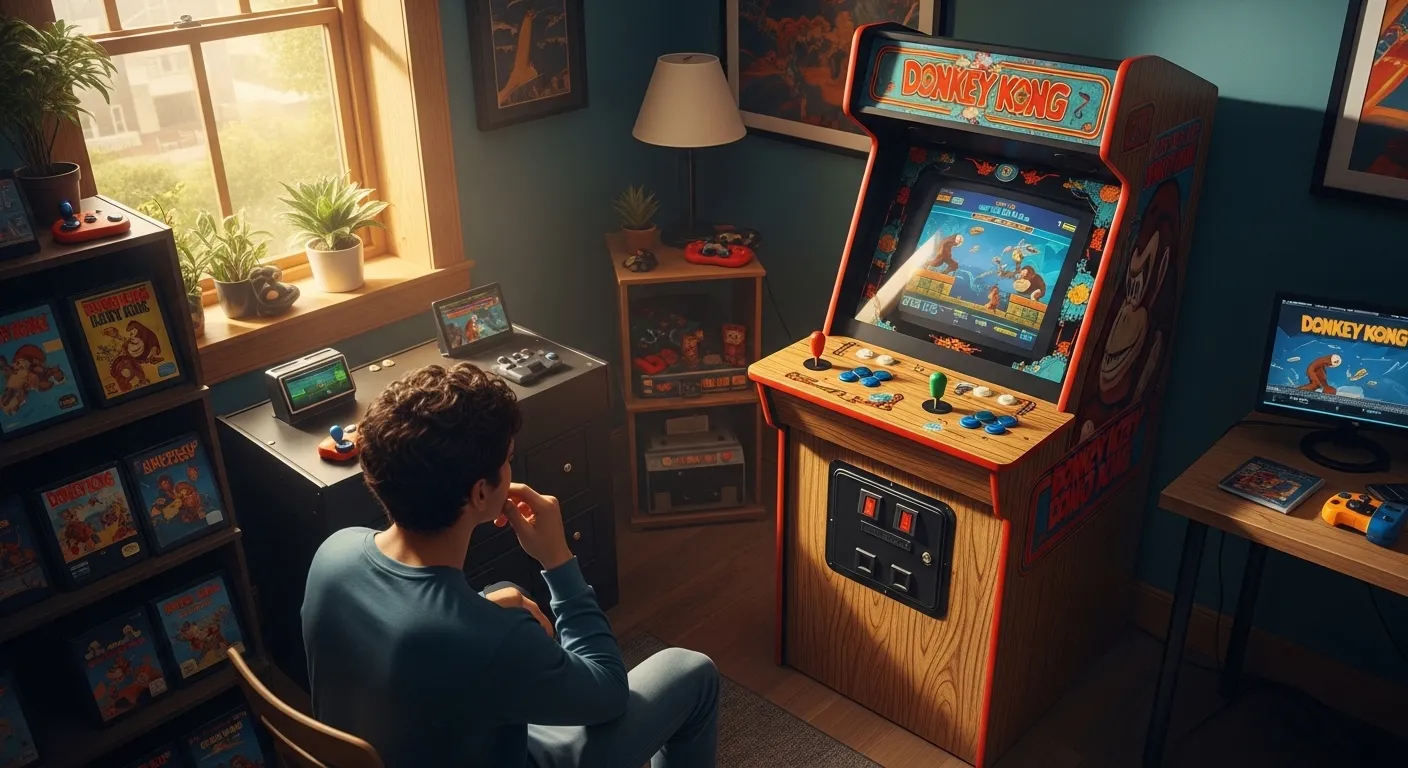
The biggest change in Donkey Kong lore came later, when the series stopped feeling like one simple rivalry and started to feel more like a whole world. That is usually the point where many fans start to feel the canon getting a little messy, and honestly, that is part of the fun.
Cranky Kong and Family Expansion
Is the original arcade Donkey Kong the exact same character as the heroic Donkey Kong in Country? Or did he become Cranky Kong, part of the older generation, while the modern lead is a descendant?
That debate is not just random fan chatter. It comes up because Nintendo let the franchise build itself in layers over time. In the original arcade game, Donkey Kong is the villain. In later games, he becomes the main hero. Cranky Kong carries the memory and attitude of that earlier era, which probably is not an accident. The result is a kind of layered mythology, strange but entertaining. The role stayed recognizable, but the identity changed.
Expanding the Kong Family and Island Setting
This was a smart move. It let Nintendo keep the famous name and image while also giving the series room for a bigger cast. Donkey Kong was no longer just one ape in one arcade building. He became part of a family line, and that opened the door for Diddy Kong, Dixie Kong, Funky Kong, and the rest of the island cast.
The Rare era did a lot of the heavy lifting. Donkey Kong Country turned a basic arcade setup into a place with a clear home on DK Island instead of just another stage, and that change matters here. DK Island felt like a home instead of a level backdrop, arguably a real place. The Kremlings became a recurring threat. Animal buddies added more personality, while the music and environmental design helped give the world its mood.
For anyone who enjoys worldbuilding in other series, this is probably where Donkey Kong became more than a premise. It became a setting that people could actually picture and return to. And if lore breakdowns in other modern myth-heavy games are also appealing, Exploring the Lore of Black Myth: Wukong, A Narrative Guide shows how a different series handles layered storytelling from a very different cultural base.
Donkey Kong Country Changed Everything
When people talk about Donkey Kong game history, the Country era is usually the point where things really changed. The arcade games made the character famous, of course. But Donkey Kong Country made the series feel alive in a very different way, and you can feel that almost immediately.
How Donkey Kong Country Expanded Lore and Gameplay
The Country games opened up the world in a few big ways at once. For one, they gave the setting a real sense of place. DK Island stopped feeling like just a name. It had jungles, caves, factories, icy peaks, and hidden areas spread across the island. That change gave the world more presence. The games also made the Kong family feel more connected. Characters had roles, attitudes, voices, and some shared history, which gave the cast a lot more personality. The series also introduced a recurring treasure idea. Bananas, hoards, and stolen goods gave Donkey Kong its own kind of mythic economy.
Environmental Storytelling and Design Philosophy
From a design point of view, this was also a big step for environmental storytelling. Players learned about the world by moving through it. A pirate ship level often says something different from a forest temple, while an industrial hideout gives off a story of its own. There is no need for a long explanation. Instead of dumping story on the player, the games let it come through platforming rhythm, enemy placement, and visual tone, which is probably a big reason it stays memorable.
According to Kensuke Tanabe’s broader design insight on Donkey Kong Country Returns, the goal of modern revival work was to keep the core feel while updating what players expect from impact and presentation.
For streamers and content creators, this helps explain why DK works so well on video. The series has clear stakes, strong movement, expressive animation, and levels that tell stories even when players skip dialogue. It is simple to follow, which really helps on a fast-moving stream. That mix makes it easy to share with casual viewers, while hardcore fans still get a lot out of it.
How Modern Gameplay Became Part of the Canon
One of the clearest ways to understand Donkey Kong lore is to stop looking only at “What is the story?” and also ask, “What does the game teach me to feel and notice?” In this series, gameplay is often part of the canon, and that really changes how the whole franchise feels and reads.
Mechanical Identity and Narrative
Look at how Donkey Kong moves compared to Mario. DK usually feels heavier, stronger, and more grounded. He slams the ground. His jumps have force, and his stages often ask players to pay attention to momentum just as much as spacing. That mechanical identity often tells you who he is before any text does, which is a pretty unusual thing.
Gameplay as Character Expression
The same idea applies to the supporting cast. Diddy often feels quick and flexible. Dixie feels more airborne, with a lot of control, and that comes across almost right away. Cranky carries that old-school challenge energy. These mechanics are not just extra features. They feel like personality in motion.
This idea also fits with newer conversations about interactive storytelling. If a broader look at how systems shape narrative in games sounds useful, AI in Gaming: How Technology is Shaping Game Storytelling explores that larger trend.
For competitive players and challenge runners, that also means lore and mastery are connected. The better someone understands level language, the better they usually understand the world. In Donkey Kong, reading the stage is part of reading the story.
Why Donkey Kong Still Matters in 2026
Some people still talk about Donkey Kong like he’s only a retro mascot. But the sales numbers say something else.
Modern Success and Cultural Relevance
Nintendo’s latest official figures show Donkey Kong Bananza at 4.52 million units sold through March 31, 2026. That puts it among the stronger modern exclusives in Nintendo’s lineup.
That number matters for more than business talk. It suggests Donkey Kong is still active right now. New players are joining the franchise today on current Nintendo hardware.
Nintendo’s Modern Approach to Donkey Kong
That kind of commercial momentum also helps explain why Nintendo seems more ready to treat Donkey Kong as a major pillar again. Recent developer material and fan discussion both point to a wider renewed push.
And if you’re watching where Nintendo and the wider industry may head next, Death Stranding 2 News: Gameplay Insights & Predictions offers another useful example.
The Cranky Kong Question and Other Canon Puzzles
No Donkey Kong lore article really feels complete without the biggest canon puzzle: who is who, exactly?
The Arcade to Modern Transition
The most common confusion is about the arcade Donkey Kong and the modern heroic DK. A lot of fans see Cranky Kong as the original arcade ape, just older and a lot grumpier now.
Canon Layers and Generational Themes
Nintendo has not always explained this in a very clear way, and that fuzziness is probably part of the franchise’s charm. Donkey Kong lore often feels less like a strict timeline and more like a family story passed down over time.
If you’re getting into current DK content yourself, Donkey Kong Collectibles Complete Guide: Hidden Locations & Unlock Rewards can be a helpful companion.
How the Series Speaks to Modern Players and Creators
Donkey Kong has held up well because its design values still fit the way people play and share games today.
Streamability and Visual Clarity
Strong silhouettes, readable movement, punchy reactions, and clear level themes work really well for streams, short clips, and community discussion.
Lessons for Indie and Accessibility Design
For indie fans, DK also works as a useful study in how platformers create identity. There is also an accessibility lesson here. Donkey Kong games often signal danger through strong visuals and clear stage setup.
If you are focused on completion, Donkey Kong Collectibles Guide: Unlock Hidden Items in All Worlds can help connect lore appreciation with practical world mastery.
A Quick Look at Where Donkey Kong Could Go Next
Donkey Kong lore will probably keep following the series’ longtime pattern: gameplay first, story told through play, and just enough canon to keep fans talking.
Future Directions and Potential Expansions
Nintendo now has proof that DK still sells games, starts conversation, and connects with different generations. That could mean deeper worldbuilding or keeping things lighter.
Frequently Asked Questions
Not fully, and that is normal for this franchise. Donkey Kong lore works more like layered game history than a strict single canon.
Many fans and many game interpretations treat Cranky Kong as the older arcade-era Donkey Kong.
Donkey Kong helped define early character-driven arcade design. It also marked a major point in Nintendo’s growth.
Donkey Kong Country turned a simple rescue-and-rival setup into a larger world with family, geography, villains, and atmosphere.
Because the core gameplay is still strong. Movement, impact, and level readability make the series satisfying for both players and viewers.
Why Donkey Kong’s Story Still Feels Alive
Donkey Kong is a good reminder that lore does not always start with some huge master plan.
Key Takeaways from Donkey Kong’s Evolution
If you step back a bit, the series history starts to show a pattern. The original Donkey Kong created drama through movement and risk, and then Donkey Kong Country opened that up into a bigger world. Later games kept refining that same feeling.
Here are the big takeaways:
- Donkey Kong lore developed gradually instead of being fully planned from the beginning.
- Gameplay rules are not separate from the canon; they are a big part of it.
- The Rare era helped turn DK from a simple premise into a fuller world.
- Modern releases show that Donkey Kong still matters commercially.
- The franchise often works best when it is read as layered mythology rather than strict timeline law.
To understand Donkey Kong better, it helps not to stop at summaries. One useful approach is to play games from different eras and see how the series feels in motion. You will find that the way the character moves and the way levels tell stories often reveal more than a plot recap. More of that is covered at Now Loading.