
If you play Stardew Valley as a chill life sim, that’s totally fine. But if the goal is getting every bit of value out of the farm, the whole game starts to feel different pretty fast. Profit is not just about planting more seeds. It comes from timing, machine use, map flow, energy control, and choosing the right crops at the right point in the game.
Advanced farming strategies matter. A farm can look full and still earn less than expected. Plenty of players lose money by buying the wrong seeds, selling raw crops too soon, or waiting too long to build machines. Others waste hours every week. Bad walking paths, weak sprinkler placement, and messy planting layouts might look nice, but they slow the entire farm down.
This guide covers the top secrets behind high-profit Stardew Valley farming. It explains how to plan around seasons, when to rush quality tools, why artisan goods take over later on, and how to build a farm that runs like a simple system instead of a pile of chores. One small idea can make a big difference. It also looks at stream-friendly optimization, common mistakes, and a few smart ways to cut burnout while still playing efficiently.
The game is bigger than ever, too. Eric Barone said, “As of February 2026, Stardew Valley had sold over 50 million copies.” That kind of reach means strong interest, lots of new players, and even more reason for clear, smart, modern farming strategies.
Why Profit Farming Starts With Stardew Valley Systems, Not Seeds
A lot of players think profit starts in Pierre’s shop. It doesn’t. Profit starts with a system. The best farms in Stardew Valley run on repeatable loops: plant, water, harvest, process, sell and replant. If one part of that loop slows down, the whole farm feels it.
That audience size says something too. Stardew Valley had 97,391 current players, a 105,089 24-hour peak and a massive 236,614 all-time peak on Steam Charts. That’s way beyond a small cozy game. The player base is huge, and it includes min-maxers, guide readers and streamers who care about efficient play.
| Metric | Value | Why It Matters |
|---|---|---|
| Copies sold worldwide | 50 million+ | Shows long-term demand for guides and optimization content |
| Copies sold worldwide in Dec 2024 | 41 million+ | Confirms rapid growth even before 2026 |
| Current Steam players | 97,391 | Strong ongoing interest from active PC players |
| 24-hour Steam peak | 105,089 | High daily engagement for a mature game |
The table makes that clear. The game still gets serious attention, and strong meta knowledge keeps shifting, especially after patch updates and the 1.6 update.
Here’s the first big mindset shift. Stop asking, ‘What crop sells for the most?’ Ask, ‘What crop fits my current tools, machines and time?’ A high-value crop can still be the wrong pick if a player can’t water it, process it or harvest it on schedule. For a closer look at smart layouts and daily flow, check out this Stardew Valley Farm Efficiency Guide.
Build Around Stardew Valley Seasonal Windows and Unlock Timing
Good players react to each season. Great ones plan two seasons ahead. In Stardew Valley, crop value depends heavily on timing. Start planting too late, ignore regrowth, or spend all your gold before the next season, and the whole profit curve can fall apart.
Early game farming strategies should focus on cash flow, not perfection. In spring, quick turnarounds help a farm grow fast. Potatoes are a strong pick because they can give extra yield. Cauliflower works too, but only if the farm can handle the slower growth time. In summer, blueberries are famous for a reason: they keep producing after that first harvest and save both gold and labor. By fall, cranberries become one of the easiest money engines in the game.
Seasonal crops also need to line up with unlock timing. Preserves Jars unlock at Farming Level 4. Kegs come later at Farming Level 8. That gap matters a lot. Before kegs are available, preserving can carry a farm much farther than many players expect. Then kegs arrive, and once they do, the best fruit usually shifts into a much stronger profit tier.
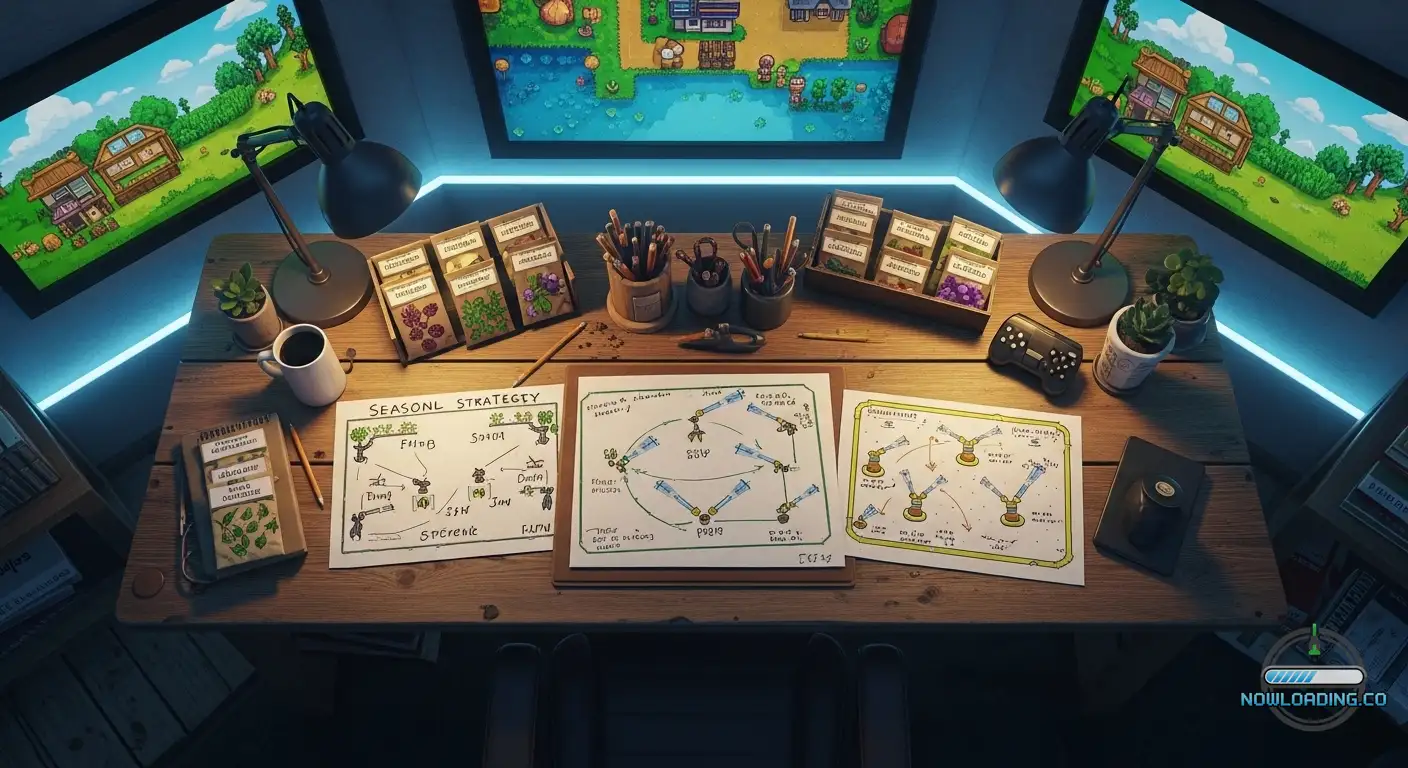
Think about the farm in layers. One layer is current profit. Another is future machine support. A third is next-season seed money. Planning around all three separates random farming from advanced farming strategies, and it can completely change which crops deserve space before the next unlock shows up.
If game guides that connect long-term planning with game systems sound appealing, Now Loading covers that style well across strategy-heavy titles.
The Real Money Secret: Artisan Goods Beat Raw Crop Sales
One of the biggest shifts in advanced Stardew Valley play is learning when to stop selling crops raw. Raw crops matter early on, but later, artisan processing brings in more money. Once that clicks, a lot of other choices start to make more sense, and planning gets easier.
Here are the key facts. A Keg unlocks at Farming Level 8 and costs 30 Wood, 1 Copper Bar, 1 Iron Bar, and 1 Oak Resin. A Preserves Jar unlocks at Farming Level 4 and costs 50 Wood, 40 Stone, and 8 Coal. Kegs turn fruit and vegetables into drinks. Preserves Jars turn fruit into jelly and vegetables into pickles. Most important, ingredient quality does not affect finished product value for preserves, and many artisan goods ignore star quality on the input.
So a silver or gold crop is not always best sold raw. That surprises a lot of players. Many put too much value on star crops and not enough on processing speed, even though the bigger question is whether the base crop should go into a machine.
For most farms, the rule is simple:
- High-value fruit usually belongs in kegs
- Large volumes of vegetables or lower-value items work well in preserves jars
- If storage is limited, process the best-value items first
- If machine count is limited, choose crops that fit your active machine type
| Processing Option | Core Rule | Best Use Case |
|---|---|---|
| Wine | Fruit base price x 3 | High-value fruit and long-term profit |
| Jelly | Fruit base price x 2 plus 50 | Mid-value fruit with earlier unlocks |
| Pickles | Strong for many vegetables | Reliable profit before large keg networks |
| Artisan Profession | +40% value | One of the best late-game multipliers |
Built around those rules, a farm stops feeling random. It feels more intentional, and that change affects how players choose crops, manage storage, and use machines across the whole farm.
I always craved another game in that style, but with ‘even more stuff.’ That’s what got me started on Stardew Valley.
The game rewards players who move beyond simple planting and start thinking in terms of conversion value. That is the real jump.
Design a Stardew Valley Farm Layout That Saves Steps Every Day
A farm can lose profit without losing a single crop. Bad movement does that. Too much walking hides waste, quietly eating time, pushing bedtime later, and making harvesting feel bigger and more tiring than it really is.
Good layouts reduce that drag. Put crops near shipping or chest zones. Keep machines in tidy rows and place kegs and jars close to harvest paths so a player can load them in one trip instead of zigzagging across the farm. Build around sprinklers early if possible, even if the first layout looks ugly. Not pretty. But ugly and efficient beats pretty and slow when money is tight.
Before-and-after comparisons make the difference clear. On a messy farm, a player might burn the first three in-game hours watering, grabbing random items from chests set too far away, and weaving through fences for no reason. On a tighter farm, that same player can finish crops fast, refill machines, and still have time for mining, fishing, Skull Cavern, or social goals.
A strong layout includes these ideas:
Centralize storage
Keep one chest area for seeds, fertilizers, and extra harvest. Don’t scatter key supplies all over the map.
Build machine districts
Group kegs, jars, looms, and mayo machines by job. Refills go much faster that way.
Use path logic
Straight lines count. Keep routes clear from house to fields, then from fields to machines and on to shipping.
Expand in blocks
Grow your farm in rectangles that match sprinkler coverage. Random shapes may look natural, but they can waste tiles.
For more profit-first layout examples, Stardew Valley: Essential Tips for Maximizing Your Farm’s Profitability pairs well with the methods here.
Upgrade Stardew Valley Tools, Energy, and Workflow Before Chasing Huge Fields
A common trap in Stardew Valley is scaling too fast. More crops can mean more money, sure, but only if your tools and energy can keep up. If they can’t, the farm stops feeling rewarding. It just starts to feel stressful.
Early on, upgrading the watering can may help more than buying another huge batch of seeds. Backpack space matters too. Once inventory fills up, every harvest takes longer than it needs to, and when watering power stays low, each morning turns into a wall of chores. That kind of slowdown spills into everything else.
Advanced farming strategies become useful when they fix real problems. Focus less on squeezing every last drop out of one day and more on removing the small bits of friction that slow down the next ten. Tool upgrades, sprinklers, food stock, and smart chest placement all help. The average day feels easier.
Players who stream or record content should keep an eye on this too. A smooth farm loop is easier to watch than a chaotic one that feels messy from start to finish. Viewers like clean systems and smart choices. Steady routines help the player too. There’s more room for commentary.
There’s a deeper lesson here. Eric Barone once said, “You should be free to work yourself to the bone, but not to force someone else to do that for you.” He said it during a discussion about development, but it also fits how many players approach optimization. Try not to build a farm that feels like a grind machine and drains the fun out of everything. Efficient play should lower stress, not add more.
That balance matters even more after the 1.6 era. New systems and end-game content give players more to manage than before.
Choose Professions and Machines With a Long-Term Plan
If the goal is maximum profit, some choices matter more than they first seem. Profession paths are a big one. The Artisan profession boosts artisan goods value by 40%, so it ends up being one of the strongest money multipliers in the game.
That bonus shifts the value of almost every crop. A fruit that looks only decent when sold raw can become excellent after it goes through a keg with Artisan. The same thing applies elsewhere. A lot of preserve chains improve a great deal too, and once that happens, raw sales become the fallback instead of the main plan.
Machine planning should match that shift. Early on, Preserves Jars are easier to unlock, and they can keep income steady while everything else grows. In the mid-game, kegs become a much bigger priority, especially once oak resin starts coming in. Later, the farm moves away from field-first thinking and leans more toward machine-first planning. Crops feed the machine network. The machine network makes the real gold.
Long-term planning matters in niche cases as well. On farms with limited open space, dense machine value can beat simply expanding the fields. On busy days, a smaller set of high-value crops, processed well, may outperform huge low-value harvests.
Players who like optimization in other strategy games may recognize the pattern right away. It feels a lot like build-order logic in shooters or grand strategy titles. You unlock a stronger economic engine, then pivot around that.
Farming for Stardew Valley Streamers, Speedrunners, and Optimization Fans
Not every Stardew Valley player goes after profit the same way. A casual solo player might want steady gold without turning every day into a stress test, while a streamer may care more about progress that shows clearly on screen and gives viewers easy goals to follow. A challenge runner usually wants the fastest value each season. The best farming strategies depend on how that person likes to play.
For streamers, farm layout matters a lot. Viewers can follow a clean berry field, a neat keg room or a simple daily route much more easily than a messy farm full of half-finished ideas and scattered plans. That matters even more in clips, short guides and overlay callouts. Clean visuals stick. A well-organized farm can become the kind of content people really remember.
For challenge players, benchmark goals help. Keep the targets simple and clear. Examples include:
- Reach Preserves Jars by a target date
- Hit Farming Level 8 before a specific season point
- Build a set number of kegs before fall
- Maintain seed gold for next season at all times
Min-max players do well with review loops. At the end of each week, ask what made the most gold, what wasted the most time and what drained the most energy. Then use those answers to tighten the next week instead of repeating the same weak spots. A short review can pay off. That kind of check-in helps improvements keep going.
Side reading can help here too. For broader ideas about adapting strategy from one game state to another, CS2 Advanced Strategies: Reading Opponent Patterns & Adaptive Play shows how useful adaptive thinking can be, even in a very different genre.
Common Profit Mistakes That Quietly Kill Your Earnings
Most farms don’t fail because of one huge error. It’s repeated small mistakes, the ones that seem minor at first, that slowly pull things down over time. They can add up fast.
Selling everything raw
That works fine early on, but later it gets bad. Once artisan options open up, keep raw sales selective.
Overplanting before sprinkler support
If the field’s too big to keep up, it’s too big, simple as that. Missed harvest timing and wasted energy quietly cut into your gains.
Ignoring machine bottlenecks
A farm that grows more crops than its machines can handle loses value. Keep things in step. Match crop volume to the number of machines.
Planting too late in a season
Planting late can tie up your money if the crop doesn’t have enough time to mature before the season ends. Check that before you plant.
Caring too much about star quality
For many artisan goods, star quality in the input just doesn’t matter as much as people think. What matters more is the base value and how the machine gets used.
Forgetting next-season cash
Right before the season changes, don’t spend everything down to zero. Keep some starter money set aside, just in case.
If one of these mistakes keeps happening, stop for a minute and rethink the system instead of just pushing harder, because a better setup works better than extra effort. Simple as that.
And for players who like mixing efficiency with roleplay and social progress, Stardew Valley: The Ultimate Guide to Character Relationships and Inclusivity is a helpful next step once the farm economy feels stable.
Small Adjustments That Create Big Late-Game Gains in Stardew Valley
Late-game profit in Stardew Valley comes from small upgrades that keep stacking over time. One extra oak resin source means more kegs later. A small shift can lead to a big payoff. Better chest placement saves a bit of time every day, and that adds up quicker than expected. A cleaner harvest route can leave more hours for caves, fishing, and special events.
Around the 1.6 update era, the game showed how alive it still feels. New systems, end-game content, rapid patching, controller fixes, crash fixes, and mod-author support changes have kept the player base active for a reason. It makes sense to check old farm habits again. A route or setup that felt great years ago might not be the best pick now.
Optimization should support your fun, not work against it. If a giant machine empire makes every refill cycle miserable, scale it down. Go for cleaner margins instead. A profitable farm that feels good to run will do better than a bigger farm that gets ignored because it turns into a chore.
It also helps to learn from strategy design in other genres. Even something far from cozy farming, like Angela Marvel Rivals: Powers, Gameplay & Strategies, shows how role focus and ability timing can change outcomes in a big way. In Stardew Valley, your ‘role’ is your farm economy. Timing still rules everything.
Frequently Asked Questions
The biggest tip is to stop depending on raw crop sales once artisan machines unlock. Preserves Jars help early, and kegs become a huge late-game profit engine. Build your farm around processing, not just harvesting.
No. Kegs are often better for high-value fruit because wine scales very well, but Preserves Jars unlock earlier and are easier to use in mid-game setups. A smart farm uses both based on crop type, machine count, and current progression.
Usually less than players expect. Many artisan goods use the base value of the crop, not the silver or gold star value of the input. That is why machine planning often matters more than saving your best-star produce.
Start by reducing walking time. Move chests closer to fields, cluster machines by type, and expand in sprinkler-friendly blocks. If you want practical layout ideas in the same style as this guide, Now Loading has related Stardew Valley articles that are easy to build from.
For most high-profit farms, Artisan is one of the best choices because it boosts artisan goods value by 40%. If your farm uses lots of kegs and jars, that profession can change your entire income curve.
A good next step is reading guides that go deeper on layouts, profitability, and specific farm systems. The Stardew Valley coverage on Now Loading is useful if you want to keep learning without jumping between random forum posts.
Put These Stardew Valley Farming Secrets to Work
Better profits in Stardew Valley don’t come from bigger fields alone. They come from smarter systems. Plan by season and watch your unlock timing. Use Preserves Jars early, then switch to kegs later when that timing makes sense. Pick crops that fit your machines instead of chasing hype. Keep it simple. Build layouts that cut extra steps. Upgrade tools before planting more than you can handle. Once artisan scaling starts to matter, focus there.
Here are the key takeaways:
- Treat farming like a system instead of a shopping trip
- Plan two seasons ahead when you can
- Use jars earlier than most players do
- Work toward kegs and the Artisan profession for late-game profit
- Design your farm to cut movement and wasted time
- Match your farming strategy to your own play style
- Avoid quiet mistakes like overplanting, raw selling and poor timing
These ideas work whether you’re a cozy solo player, a guide writer or an aspiring streamer. Start with one fix today. Rework a field. Or move a machine line. Save up for a better seed fund if that’s your next step. In Stardew Valley, small smart changes can grow into big long-term profit over time.