
Gaming already feels different from a few years ago. Enemies react faster, worlds feel less fixed, and menus start picking up on what you use most, which you’ve probably noticed. Some games even change dialogue, quests, or difficulty based on the way you play. That shift is not just better design by itself. A lot of it comes from AI in gaming.
For anyone paying attention to where games are headed, this matters right now. AI is moving beyond the back end of development and showing up right in the player experience. Studios use it to build worlds faster, support smarter bots, improve moderation, and try new ways to shape stories. For players, streamers, indie creators, and small teams, that opens up some exciting possibilities, along with a few big questions. It also brings real concerns about fairness, creativity, jobs, and trust.
The numbers make the speed hard to ignore. The AI in gaming market is estimated at $4.54 billion in 2025 and could reach $81.19 billion by 2035. Developer use is rising quickly too, with many teams already working generative tools into daily production. So the question is no longer whether AI will affect games. What matters now is how far it goes, where it shows up most, and whether it actually makes games better for you.
In this guide, we’ll look at how AI is changing gameplay, storytelling, esports training, indie development, accessibility, and player-created content. We’ll also look at the limits of current tools, because hype alone does not build great games. For now, AI seems more likely to shape the future of gaming as a co-pilot rather than a full replacement for human creativity.
Why AI in Gaming Is Becoming Core to Modern Game Design
AI in games used to handle fairly basic jobs: enemy pathfinding, rubber-banding in racing games, and simple bots in offline modes (nothing too fancy). Its role was pretty limited. Now, that role has grown in a big way.
Today, AI can help build environments, test levels, study player behavior, create voice variations, and even shape how non-playable characters respond in real time. That broader use has moved AI in gaming into a core part of design instead of keeping it as a mostly hidden tool behind the scenes (and that’s a real change).
The industry data stands out. GDC’s State of the Game Industry 2024 found that 60% of U.S. game developers said they use generative AI in their workflow, while 52% said they expect to use it in the future. Boston Consulting Group also reported that approximately 50% of studios are now using AI. That does not mean half of games are being fully made by AI. Instead, it means these tools are now part of regular production work.
| Metric | Value | Why It Matters |
|---|---|---|
| AI in gaming market | $4.54B in 2025 | Shows strong commercial momentum |
| Projected market size | $81.19B by 2035 | Signals long-term investment |
| U.S. developers using generative AI | 60% | AI tools are already common in workflows |
| Studios using AI | About 50% | Adoption is moving into the mainstream |
For players, the main point is pretty clear. Gaming is likely moving toward more reactive systems and more personalized experiences. If you follow trends on Now Loading, that fits the broader shift toward smarter, more adaptive games and tools across the industry. It also connects to bigger conversations about community-driven design, including what fans expect from live-service shooters in Battlefield 6 Features Shaped by the Community.
Smarter Gameplay and AI in Gaming Worlds
One of the most noticeable ways AI changes games may be in how gameplay responds to the player in a more natural way. NPCs are the clearest example. Older NPCs usually follow obvious scripts: they patrol fixed routes, repeat the same lines, and switch between a few states like idle, alert, attack, or retreat. Newer AI systems can make that behavior feel less robotic and more tied to what is actually happening around them.
That does not always mean fully generated behavior. In many games, it is more about layered systems that work together. A game might track how you move, which weapons you rely on, how often you use stealth, and how fast you clear missions. From there, it can change enemy search patterns, squad coordination, or even dialogue responses. The result is a world that feels more aware of what you are doing.
Mordor Intelligence found that NPC behavior and dialogue generation is one of the fastest-growing AI areas, with projected 31.38% CAGR through 2031. That makes sense. Smarter NPCs can improve almost any genre. In shooters, bots can become better training partners. In RPGs, side characters can feel more believable. Survival games can use AI to create shifting events, resource pressure, social tension, and sudden setbacks, which can turn chaotic pretty fast.
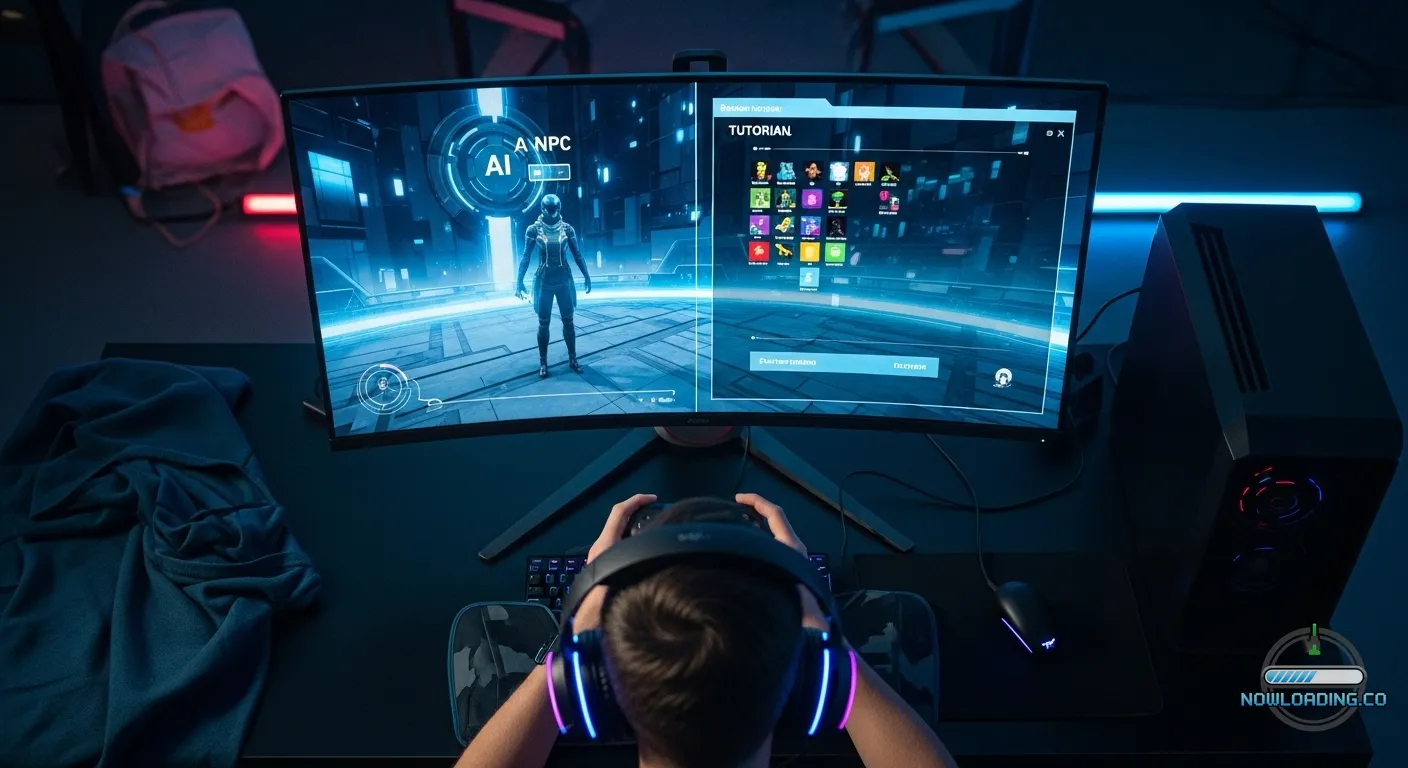
The difference between scripted play and reactive play is easy to see. In a scripted mission, the same patrol takes the same route every time. In a reactive mission, that patrol may tighten security if loud weapons keep appearing, split up after repeated rooftop sniping, or start setting traps if the same flank route gets overused. That changes the feel of the whole encounter. Instead of solving a fixed puzzle, the player is dealing with a system that notices patterns and responds.
That could have a strong effect on tactical games, co-op shooters, and open-world sandboxes. It also fits with the growing interest in AI-heavy survival systems. For more on that, we covered it here: Top Survival Games with AI-Enhanced Worlds: Procedural Events, Resource Scarcity & Player Strategy
AI and Storytelling: Better Tools, Not Better Authors Yet
The debate gets most serious around storytelling. AI can help writers brainstorm, build lore trees, come up with quest variations, and test dialogue branches, which is genuinely useful. But that still doesn’t make it a replacement for strong human narrative design. Right now, the evidence points the other way. AI is getting more useful inside writing workflows, while emotionally powerful stories still come from people. Human people.
GDC’s 2024 data found that 18% of developers use generative AI for writing and dialogue, 18% use it for narrative and quest design, and 16% use it for story, lore, or worldbuilding. That matters because AI is already part of story work in a real way. Even so, adoption and trust are not the same thing, and that gap matters.
There are useful elements of AI right now, for instance, training your bug database to query how many bugs you have in certain situations. But what it can't do is tell me a really compelling story that has a three-act structure, or even tell me multiple scenes. It gets extremely confused.
That quote gets right to the issue. AI works well with patterns, remixing, and variation, but it is much weaker at keeping together long-form emotional structure. It can generate ten quest ideas quickly. What it still struggles with is building a memorable arc with pacing, payoff, character growth, and the kind of emotional buildup players actually carry with them afterward.
Before AI-heavy tools showed up, many narrative teams spent a lot of time on first drafts, flavor text, and branch testing. Now, with AI-assisted workflows, a team may move faster through rough ideas and leave more room for polishing the human moments. That’s the best-case version of it. AI can take on the scaffolding, while writers handle the parts that need judgment, feeling, and taste.
Leigh Alexander offered a more balanced view of this shift.
I think AI will bring big changes to every creative field over the next few years, but not in an apocalyptic way.
That middle ground is useful. AI-assisted stories may well be part of the future of gaming, but the games people care about most will still depend on human taste, editing, and empathy.
The Indie Advantage: Faster Prototypes, Lower Costs, Bigger Ideas
Big publishers aren’t the only ones that could benefit here. AI in gaming may help indie studios even more, because small teams run into hard limits with time, budget, and how much content they can realistically make. A two-person team usually can’t build a giant world, test thousands of dialogue branches, or handcraft huge amounts of art variation. AI tools give them a way to try more ideas without needing the same amount of resources.
That still doesn’t mean pressing one button and getting a finished game. Not even close. What it does change is how fast prototyping can move. An indie dev can mock up enemy behavior, sketch side quest options, create environment concepts, and even make placeholder voices for testing, which cuts down a lot of back-and-forth. Instead of waiting weeks to try an idea, they may be able to test it in days.
Iteration is usually the hardest part of game development, especially for smaller teams. Good games come from trying things, failing, cutting ideas, and refining what actually works. AI can shrink the gap between an idea and a playable test. That gives indies more room to experiment with mechanics, mood, and narrative branches, while showing earlier what is really worth keeping.
Research points the same way. In the generative AI game environment and narrative design market, platforms and software held 74.12% share in 2025, while environment generation held 34.82% share. That suggests teams are spending on flexible creation tools instead of treating AI like a one-off gimmick.
There are real risks too. If every indie relies on the same AI models and similar prompts, games can start to look and sound alike. Originality gets harder, and players usually notice when a world feels generic. The strongest indie use case, then, is not replacing the creative voice. It is removing bottlenecks so that voice has more room to come through.
That effect may show up across many releases built around procedural systems, compact teams, and strong hooks. And while the spotlight stays on huge projects like The Impact of GTA VI on the Gaming Landscape: A Look Ahead to 2026, AI could also widen the gap between blockbuster spectacle and clever indie creativity.
Competitive Gaming, Streaming, and Better Player Coaching
For competitive players and streamers, AI is becoming more than a dev tool. It’s starting to affect performance in direct, practical ways. Coaching systems can break down aim habits, movement choices, ability timing, and map routes, which matters a lot in matches where small mistakes keep happening. Moderation tools can help manage chat and cut down toxic behavior. Recommendation systems may surface stronger clips, better titles, and smarter stream timing. Each change might seem small on its own, but together they can improve both gameplay and content creation.
Picture a ranked match review. Instead of only rewatching the replay, an AI assistant could point out repeated mistakes like late rotates or poor crosshair placement on one specific angle, then show wasteful utility use in important rounds. In fighting games, it might catch unsafe habits that players stop noticing over time. In MOBAs, it could track bad objective timing. In battle royales, it may compare a loot path against options that are safer or just faster.
That kind of coaching could start to feel normal pretty soon, especially for players focused on esports. Streamers can benefit from the same change. AI can clip highlights, make chapter markers, detect dead air, and suggest thumbnail ideas. Used carefully, it saves time without making content feel fake or weirdly overprocessed.
There’s a fairness question too. If AI becomes a strong training layer, skilled players may improve even faster. That could raise the skill floor in ranked games and tournaments. It may also change how aspiring creators try to break into the scene. Better setups and community tools have already changed content workflows around modern shooters and franchise updates such as Call of Duty 2026: The Game-Changing Features You Need to Know.
Balance still matters here. AI works best as a review and support layer without flattening a player’s style. Cleaner decisions are useful; robotic play is not.
Accessibility and AI in Gaming Design
Accessibility is one of the most interesting uses of AI in gaming, even if it gets much less attention than flashy NPC demos. Games can adapt to different player needs in real time, and that opens the door to genuinely useful changes. Think dynamic subtitle sizing, better speech-to-text, smarter menu navigation, and difficulty systems that respond to trouble spots without making players feel punished for having a hard time.
Cloud growth alongside AI could expand this a lot. Boston Consulting Group projects cloud gaming revenue rising from about $1.4 billion in 2025 to $18.3 billion in 2030. If more AI processing moves to the server side, games could support deeper adaptive systems without asking every player to own expensive hardware. That matters most for players who need those features but do not have high-end setups.
There are wellness benefits too. If games notice repeated failure points, they can offer support instead of adding more frustration. Competitive features might suggest shorter practice goals instead of pushing endless grinding. Moderation systems may catch abuse faster as well. And for players with motor, visual, or cognitive needs, adaptive interfaces can make large, complex games much easier to enjoy.
The harder part is privacy and transparency. If a game collects play patterns, voice data, or behavior signals, players deserve to know that clearly. Helpful AI can stop feeling helpful very quickly if it becomes invasive. Gaming will feel better if adaptation is opt-in, easy to control, and clearly explained.
The Trust Problem: Originality, Disclosure, and Creative Labor
AI can be useful, but it also causes friction. Players and developers are already pushing back on copied styles, poor disclosure, floods of low-quality content, and the effect this could have on creative work. Those concerns are real, and they directly affect how much trust people give to AI-made systems and assets.
Boston Consulting Group reported that around 20% of new games on Steam disclose AI use. That is about double the share from a year earlier, and about 7,300 games on Steam now include some kind of AI disclosure. Use is spreading quickly, so disclosure is becoming a much bigger part of the conversation as well.
A lot of this comes back to authenticity. If AI is handling bug support, testing, moderation, or similar behind-the-scenes tasks, many players may not care much. However, the reaction can shift quickly if it is used to copy artists, replace writers, or flood storefronts with cheap content. Even players who are open to trying new things usually still expect honesty about how the work was made.
Studios will need clear rules. Labels should be easy to understand, creators should be respected, and human review still needs to stay part of the process. Careful editing matters too, especially when something goes wrong and companies need to offer real accountability instead of vague promises. AI may be a tool, but people are still responsible for the results.
This gets even more intense in massive franchises and heavily watched releases. Expectations are already high, and small production choices can turn into public debate. Community trust is already shaping hype cycles around games, from shooter roadmaps to major sequels.
What the Next Five Years May Actually Look Like
Gaming over the next five years will probably move ahead in smaller, useful steps instead of jumping straight to fully AI-made masterpieces. That slower path feels more realistic, and honestly, it leaves room for features people will actually notice: more adaptive NPCs, better live balancing, faster prototyping, smarter moderation, and personalized accessibility. Quest and dialogue updates should get faster too. Creator tools will likely get better as well, especially for modders and streamers who usually use them in practical, visible ways.
Player-made content could grow even more during that time. Boston Consulting Group found that 40% of gamers are consuming more user-generated content than they were a year earlier. AI may speed that up by making it easier to build maps, stories, challenge runs, and social content without so much hassle. If that happens, gaming starts to feel more collaborative, with players taking part in the creative process instead of only using what studios release.
Hardware will still play a big role, just not always in the same way as before. Some AI features will run on-device because speed and privacy matter there. Others will stay in the cloud, where scale makes more sense. That split could shape everything from handheld gaming to high-end PC setups. It may also help new social formats grow, including local and hybrid play experiences like those explored in Board Console Launch 2025: Face-to-Face Gaming Revolution.
The games that benefit most will probably be the ones using AI in quieter ways, without making it the whole pitch. They’ll just feel more alive, fair, and responsive, and players will notice that difference even when the tech stays in the background.
Frequently Asked Questions
AI in gaming means using computer systems that can analyze data, react to player behavior, and generate or adjust content. It can power smarter enemies, dynamic dialogue, better matchmaking, accessibility features, and developer tools.
Not fully, at least not in the way great games need. AI can help with ideas, rough drafts, testing, and variations, but human creators still do the best work when it comes to emotion, pacing, tone, and memorable characters.
It can improve bots, training tools, replay review, anti-cheat support, and personalized coaching. That means players can get faster feedback on mistakes and build better habits with less guesswork.
Yes, if it is used with care. It can help small teams prototype faster, test more ideas, and handle repetitive tasks. For readers who like following these shifts, Now Loading covers gaming tech and trend stories that help put indie AI changes in context without overhyping them.
They can be, especially if teams rely too much on generic prompts or weak editing. The strongest games use AI as support, then shape the final result with human direction, style, and clear creative choices.
Look for coverage that tracks both player experience and industry change, not just flashy demos. A site like Now Loading is useful because it connects AI in gaming with broader topics gamers already care about, like hardware, competitive play, accessibility, and upcoming releases.
The Bottom Line on AI and the Future of Play
AI is already part of gaming. It helps studios work faster, makes gameplay feel more responsive, improves player coaching, and gives indie teams and accessibility features more room to grow, which is a pretty big deal. All of that is truly useful. Still, the limits are easy to spot. AI can support stories, but it does not reliably replace great storytelling. It can personalize systems, but player trust still has to be earned. And even if it saves time, it should not come at the cost of human creativity.
The future of gaming is not really about AI versus humans. What matters is how well people use AI in real game development. Over the next few years, the strongest games will probably come from teams that use smart tools without losing their own voice. That balance will shape a lot of what players connect with.
Here are the main points:
- AI is becoming a regular part of game development and live operations.
- Smarter NPCs and adaptive difficulty are big growth areas.
- Personalized systems are growing too.
- Human writers still matter most for strong emotional storytelling.
- Indie teams can get real speed and flexibility with AI-assisted workflows.
- Competitive players and streamers may benefit from better coaching and support tools.
- Accessibility could become one of AI’s most important long-term gains.
- Trust, disclosure, and originality will shape whether players accept it.
So what should people watch for? New features are worth testing with a critical eye. Studios that use AI responsibly will likely stand out. No hype needed. The future of gaming will not be built on hype alone, but on better design, better tools, and smarter choices.