
If you’ve played even a few Vampire Survivors runs, you already know how fast the game shifts from calm to total chaos. One minute you’re picking up gems and everything feels manageable. Then, almost suddenly, the screen is packed with bats, skeletons, bosses, and all kinds of nonsense. That’s why learning the best Vampire Survivors weapons matters so much. A strong build helps you survive longer, and it often changes how the whole run feels, which is really the main point.
Some weapons feel great early on and then drop off later. Others start a bit slow but turn into run-carrying monsters once they evolve. A few are strong enough to cover weak movement, bad luck, or risky pathing through dense enemy waves and heavy boss pressure. That kind of power makes a real difference. If you’re into strategy, planning builds, or just trying to get through runs with less chaos, knowing which tools are actually overpowered gives you a real edge, especially once everything starts spiraling.
This guide goes over the most overpowered weapons in Vampire Survivors, why they work, when they shine, and how to build around them. It covers early-game strength, late-game scaling, defensive picks, boss-melting tools, and the best synergies. You’ll also find common mistakes, streamer-friendly builds, and practical tips for different play styles. When the screen turns into total chaos, getting cleaner runs, better clears, and more control usually comes down to choices like these.
What ‘Overpowered’ Really Means in Vampire Survivors
In Vampire Survivors, ‘overpowered’ doesn’t just mean the weapon with the biggest damage number. A weapon usually feels overpowered when it deals with several problems at once, and that’s often the real test. It can clear crowds, hurt bosses, keep your path open, scale into minute 30, and still stay useful when the screen gets hard to read. The strongest options usually cover more than one role, and they do it without asking much from the player, which matters a lot here.
That helps explain why King Bible, Santa Water, Lightning Ring, Laurel, and Clock Lancet come up so often in high-level discussions. These weapons create space, control enemy movement, or simply help your character stay alive longer. Their evolved forms push those strengths even more. Unholy Vespers can lock down the area around your character. La Borra turns the nearby floor into a death zone. Infinite Corridor and Crimson Shroud also make brutal late-game moments, especially during the heaviest enemy waves, much easier to handle.
The clearest way to judge power here is to compare four factors side by side.
| Weapon Trait | Why It Matters | Best Example |
|---|---|---|
| Crowd control | Stops swarms from touching you | Unholy Vespers |
| Boss damage | Helps remove tanky elites fast | Infinite Corridor |
| Area denial | Lets you farm safely while moving | La Borra |
| Survival value | Covers mistakes and bad map pressure | Crimson Shroud |
With that view, ranking the best Vampire Survivors weapons gets a lot easier. The top tier is full of tools that often save runs, not just flashy picks. It’s simple, but it changes a lot. If looking at game systems is your thing, you may also like Vampire Survivors weapons: Design Lessons for Player Engagement, which looks at why these mechanics feel so satisfying in the first place and why they usually keep feeling good even after lots of runs.
The Early-Game Monsters That Carry Weak Starts
A lot of runs are decided in the first ten minutes. When the opening feels smooth, leveling comes quicker, stage items are easier to pick up without taking dumb risks, and evolutions can start coming online before the real pressure shows up in the mid-run waves. That is why some basic Vampire Survivors weapons can feel strangely overpowered long before they evolve.
Garlic is the obvious example. Veterans still argue about how well it keeps up later, but in the early game it wipes out weak enemies and lets you move through packs that would wreck other starts in the first few minutes. It is not always the weapon that carries the whole run to the end. Still, it gives huge comfort, fast farming, and extra breathing room for newer players. For casual clears and lower-stress runs, that usually matters a lot, especially if the goal is to avoid a rough opening.
King Bible is a strong all-around pick too. Even before evolution, it creates a rotating wall that punishes anything trying to get close. With enough upgrades, it starts to feel like built-in safety, since enemies get stopped right next to your character instead of reaching melee range. That makes it especially useful for players who like moving aggressively around the map but still want protection.
Runetracer is another standout. It can seem random at first, but on tighter stages or near terrain, it keeps bouncing through enemies again and again. That gives it excellent early damage, and the scaling often stays strong. Song of Mana fits here too. It hits hard and controls lanes well by clearing straight paths in front of you, while still staying useful into later waves.

A simple early-game framework helps a lot:
Prioritize one stabilizer
When things get crowded, it helps a lot to pick one weapon that will likely keep you alive. I think King Bible or Garlic are great choices: simple, solid, and easy to use.
Add one scaler
Pick a weapon that usually gets stronger as upgrades add up; that often helps. Like Runetracer or Lightning Ring, and you’ll probably notice it.
Build toward an evolution path
Instead of only trying to survive at minute five, it often helps to think about what your accessories might open up by minute fifteen.
That kind of planning usually matters in a lot of survival-heavy games. If run planning or team loadouts sound fun, Mastering Helldivers 2: Essential Co-Op Strategies for Victory covers a similar way of thinking on a very different battlefield, which is honestly pretty fun.
The Mid-Game Kings: Evolutions That Flip a Run
A build usually starts to feel truly dangerous when a solid weapon finally evolves. In Vampire Survivors, evolutions are not small upgrades. They create the kind of power jump that can change an entire run. A setup that seemed weak, awkward, or just okay can suddenly become stable, efficient, and much harder to break through, which is often the moment when everything starts clicking.
Santa Water evolving into La Borra is one of the clearest examples of that change. Regular Santa Water often feels a little awkward, mostly because the bottles land away from the place where you need help most: right around your character, where enemies are closing in. Once it turns into La Borra, those zones get bigger, start drifting toward you, and tear through enemies across large parts of the screen. Movement starts to feel more like leading enemies through a farming route. You move, they follow, and then they walk straight into damaging pools around you.
King Bible becoming Unholy Vespers is another big swing. With the cooldown reduction and the near-constant orbit, your character starts to feel protected from anything getting too close. It is one of the simplest ways to steady a run once the screen starts filling up during the mid-game and later waves. That is also why so many guides put it near the top of Vampire Survivors weapons when consistency is the priority, especially if the goal is surviving dense enemy packs without having to keep moving around.
Lightning Ring into Thunder Loop is less about comfort and more about getting strong value across the whole screen. It keeps striking, adds heavy damage coverage, and stays useful even when enemies are pushing in from every side. For builds that feel active without demanding precise aiming, this tends to be an excellent pick. It is simple, strong, and reliable.
The mid-game is often easiest to understand in simple before-and-after terms:
- Before evolution: you’re reacting to danger.
- After evolution: your build starts controlling space.
That change is a big reason overpowered weapons matter so much. They reduce panic and give you room to breathe. That extra space lets you think about loot, map movement, and boss timing instead of spending every second scrambling to stay alive, which is honestly a big deal in practice. In many runs, it means deciding where to go and what to grab, rather than just running from whatever is nearest.
If you’re interested in how smart systems shape player decisions, we covered that here: AI in Gaming: How Technology is Shaping Game Storytelling.
The True Endgame Breakers: Infinite Corridor and Crimson Shroud
When people talk about the most overpowered weapons in Vampire Survivors, two names usually come up first: Infinite Corridor and Crimson Shroud. They are not just strong options. They change how late-game survival feels, and that is a big reason they stand out so much.
Clock Lancet already has real value before it evolves, since freezing enemies gives you time to recover. After a bad movement choice, it can save a run, and it also creates safer paths through the heavy waves closing in around the player. Once it becomes Infinite Corridor, though, the run often starts to feel completely different. Its main strength is the repeated health reduction on enemies. That matters a lot against tough late-game enemies and bosses, especially when enemy health scaling starts getting ridiculous. It does not really care if something has turned into a giant health sponge. It deals with that exact problem, which is why people rate it so highly.
Laurel fixes a different problem. Even at base level, its shield charges are a strong safety net. After evolving into Crimson Shroud, it becomes one of the best defensive tools in the game. Incoming damage gets reduced so much that many dangerous moments stop feeling nearly as scary. That gives aggressive players more room to move greedily and push through riskier routes in enemy packs. Newer players, meanwhile, get more space for mistakes that would normally end a run, which is a big part of what makes it so useful.
Used together, Infinite Corridor and Crimson Shroud make up one of the best-known power pairs in the game. One keeps survival manageable, while the other handles enemy health scaling. Because of that, late-game builds usually feel much more stable and a lot less desperate once both are active.
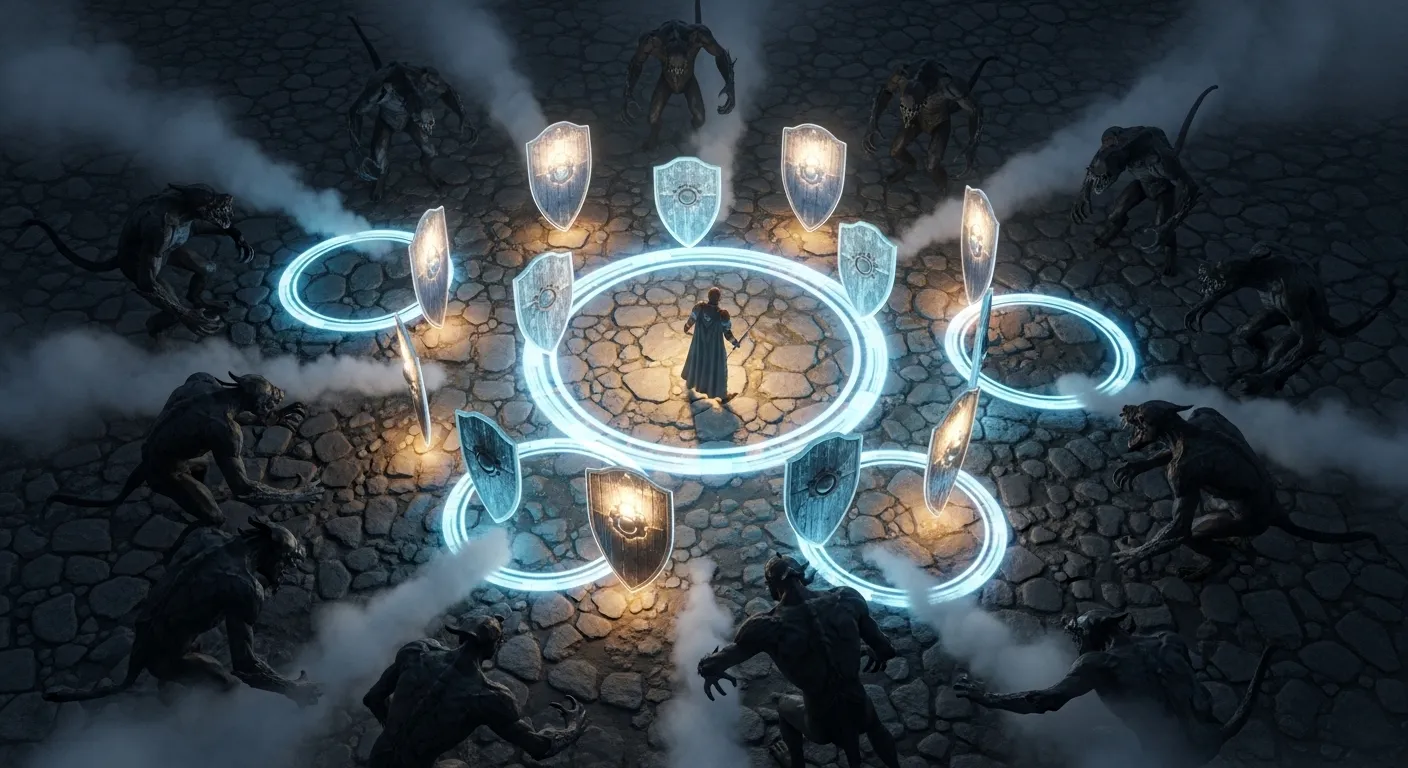
This is also where implementation matters. Planning passive items, chest timing, and map route is a big part of building them well. Wait too long or take random upgrades, and the smooth setup can fall apart. In Vampire Survivors, strong strategy often has less to do with reflexes and more to do with reaching this power spike at the right moment.
Weapon Synergies That Feel Unfair in the Best Way
The strongest runs usually do not come from one weapon doing all the work on its own. They usually happen when your whole loadout works together like a system. A weapon can already be strong by itself, but it often starts to feel overpowered when another weapon or passive covers what it is missing, and that is usually the real trick. In most runs, that is what turns a decent build into something you can actually count on.
La Borra plus Unholy Vespers is a great example. La Borra melts the ground around your path, and Unholy Vespers keeps enemies away from your body at close range. Together, they make crowded areas much easier to move through and let gem farming happen with a lot less pressure. If Thunder Loop gets added too, the build also reaches across the screen, hitting enemies before they even get close to your position, which honestly feels a little unfair.
Phieraggi is another famous power spike. It takes setup, but once it is online, it gives huge coverage and strong damage that keeps going. It shows how a weapon can really pay off when you fully commit to it for an entire run. Vicious Hunger is more divisive, but in the right farming build, it can create a really fun snowball effect. Not every high-damage option feels equally stable, which is exactly why synergy often matters more than hype.
A practical rule is to balance your six weapon slots around a few clear jobs:
Body protection
Think: Unholy Vespers, Garlic, and maybe Laurel.
Area pressure
Examples: La Borra and, I guess, Song of Mana. Also Thunder Loop.
Boss or scaling answer
Examples include Infinite Corridor, Phieraggi, and other strong evolved projectiles.
If players ignore one of these jobs, the build usually feels weaker than expected, and that happens pretty often. You can see a similar pattern in other strategy-heavy games too. And for anyone who likes comparing systems and role coverage, Civ 7 Civilizations Ranked: Unique Abilities, Tech Paths & Victory Strategies looks at a very similar idea on a much bigger scale, and maybe in a more complex way.
The idea is pretty simple: don’t focus only on damage. Coverage usually works better, because it helps with bosses, groups, and scaling.
Best Overpowered Weapons for Different Play Styles
Not every player wants the same thing from a run. Some want the safest clear possible, others want fast farming, and plenty just want flashy chaos for clips, streams, or simply because that style is fun. The best Vampire Survivors weapons change a bit depending on what that specific run is trying to do, and that is honestly part of the appeal.
For safer clears, King Bible, Laurel, Clock Lancet, and Santa Water still sit near the top. They are reliable picks because they give you more control and a little breathing room once enemies start closing in and the screen gets crowded. Farming builds lean a bit differently. Garlic can still feel great early on, while La Borra and other high-uptime AoE tools usually make gem collection faster by clearing space around the character and keeping enemy waves under control. For boss pressure, Infinite Corridor is still one of the strongest options since it keeps scaling even when enemy health gets ridiculous, which usually happens sooner or later.
If the game is being streamed, readability matters too. Some builds are powerful but look messy on screen, and that can make chaotic moments harder for viewers to follow. Other setups hit just as hard while staying much clearer visually. Unholy Vespers and La Borra often show that well: enemies push in, space shrinks, and then the build takes over. That tends to work nicely in clips, live commentary, or when teaching newer players, which probably matters more than people admit.
There is an accessibility angle too. Not everyone wants high-input dodging. Weapons that add passive defense or wide area control can lower stress and make constant precision less necessary. That alone helps runs feel more comfortable, especially in longer sessions or on tired days.
More players are finding indie hits through guide culture and streaming, and sites like Now Loading matter here because they connect pure strategy to the broader gaming lifestyle, including content creation and smarter play habits.
Common Mistakes That Make Great Weapons Feel Average
A lot of players pick strong weapons and still lose. Usually, the weapon is not the real problem. More often, the issue is the build path, and that can be easy to miss.
One of the most common mistakes is taking too many weapons that all do the same job. When the whole loadout becomes a pile of random projectiles with weak defense, the damage may look good at first, but tight spaces still turn into a trap. That gets annoying fast. Another problem players run into often is skipping the passive items needed for evolution. A run may feel strong around minute eight, then collapse by minute eighteen because the setup was too unfocused.
Movement is another area where things go wrong. After getting a powerful weapon, players often stay still longer than they should. Strong tools can make a run feel safe, but smart pathing still matters. In most cases, the weapon should support the route instead of deciding it. You will usually do better by kiting toward gems, chests, or stage items.
Quick troubleshooting helps:
- Dying to swarms? Add body protection like King Bible or Laurel.
- Bosses taking too long? Think about building toward Infinite Corridor or using stronger focused damage.
- Getting hit while looting? More area denial, like La Borra, often helps.
- If the build feels strong but messy, cut overlap and decide what each weapon should do.
If adapting to different systems and improving under pressure sounds appealing, Dune: Awakening Gameplay Mechanics and Strategies for New Players is another useful read on how planning probably beats panic.
Where the Meta May Go Next
Even in a game built on wild excess, the meta keeps changing as players try DLC tools, character synergies, Arcana picks, and routes tied to specific stages, which is a big part of the fun. It rarely stays the same for long. What usually remains true is that the most overpowered weapons tend to offer steady control or utility that bends the normal rules a bit.
That is why future top-tier debates will probably keep coming back to a few familiar ideas: survivability, scaling, easy coverage, and how naturally a weapon fits into a run. Those are still the core ideas. Weapons that check those boxes are often hard to ignore. And while DLC additions can change rankings, they still have to deal with the same pressure points that appear in every run.
For actual play, locking one tier list into memory forever usually does not work. A better approach is learning why the best weapons work. Does this weapon protect the player? Does it scale well? Does it help movement? If the answer is yes more than once, that is probably a meta pick.
These habits also carry over well across modern games. Build logic, role balance, and adaptation usually matter whether the player is fighting hordes or raiding dungeons. It is a different game, but often the same mindset, in my view. That also applies when looking ahead to future releases like those discussed in Death Stranding 2 News: Gameplay Insights & Predictions.
Frequently Asked Questions
There is no single answer for every situation, but Infinite Corridor is often the strongest late-game pick because it crushes high-health enemies. For all-around comfort and consistency, Unholy Vespers and La Borra are also top-tier choices.
Garlic is very strong in the early game and great for comfort, farming, and low-stress runs. It falls off compared to the best late-game options, but that does not make it bad. It just has a different role.
For many runs, Unholy Vespers or La Borra are excellent first targets because they improve survival right away. If your run already feels safe, aiming for a stronger scaling option can make sense.
Yes, often more than players expect. A defensive weapon like Laurel or King Bible can protect your run long enough for your damage tools to scale. Staying alive is part of doing damage.
A very safe setup includes King Bible, Santa Water, Laurel, and Clock Lancet, supported by smart passive items for evolution. It gives crowd control, survival, and strong late-game answers without demanding perfect movement.
Your Next Run Starts With Better Choices
The main point here is pretty simple: in Vampire Survivors, the most overpowered weapons usually are not the ones with the craziest visuals. They are the ones that deal with problems before those problems wreck your run, which is often what really ends it. Unholy Vespers keeps the area around you safer. La Borra turns big parts of the map into danger zones for enemies. Infinite Corridor stops late-game scaling once mobs start getting out of hand. Crimson Shroud makes surviving much easier. Strong early picks like Garlic, Runetracer, Song of Mana, Lightning Ring, and similar choices help you reach those bigger power spikes in the first place.
If you want better strategies, it helps to think in roles instead of just grabbing random favorites. One useful approach is setting up one weapon for safety and another for area control, while leaving room for scaling or boss pressure, because that kind of balance matters more than many people expect. Planning evolutions early helps too. Watch your passive items, and keep moving with purpose. In most runs, that is what keeps things steady instead of letting them fall apart.
Here are the key takeaways:
- Prioritize stability in the first ten minutes.
- Evolved weapons are where many runs really start to snowball.
- Infinite Corridor and Crimson Shroud are still top-tier picks for late-game control.
- Synergy matters more than raw damage when building a full loadout.
- Good planning makes great Vampire Survivors weapons hit even harder.
So when the next run begins, skipping the flashy option can make a real difference. Go with what actually wins. That small change in approach often decides whether a run barely stays together or ends with the whole screen under control, and that gap is huge.